

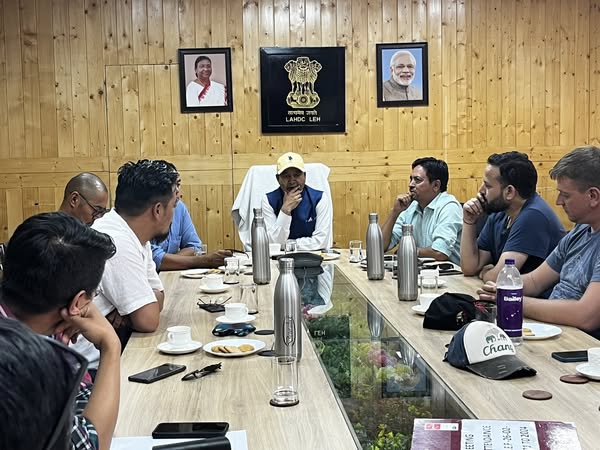
Leh: Executive Councillor (Minority) Ghulam Mehdi chaired a high-level meeting at the Council Secretariat to address the growing concerns of climate change and sustainable development in the Ladakh Himalayas. The meeting brought together councillors from various constituencies, including Temisgam, Hunder, Phyang, Sku-Markha, Saspol, and Lamayuru, along with nominated members.
The session featured an interactive exchange with a visiting team of professors and researchers from PGDAV College, University of Delhi; the Centre for Interdisciplinary Studies on Mountain and Hill Environment (CISHME); the Institute of Mountain Environment, University of Jammu; and HSE University, St. Petersburg, Russia. The delegation is currently conducting an international field workshop on climate change in the Indian Himalayan Region and shared their findings from recent fieldwork across Leh and Kargil, including villages such as Alchi, Saspol, Hanu, and Salma.
Their research revealed significant signs of environmental stress, including glacial retreat, erratic rainfall, and water scarcity, all of which are affecting agriculture, traditional livelihoods, and daily life. Professor Rahul Gupta emphasized the need for cross-community studies to understand the social impacts of climate change, while Professor Vandana Mishra underlined Ladakh’s high vulnerability to climate disturbances. Dr. Pardeep Singh advocated integrating indigenous knowledge with modern climate tools to develop grounded, effective policies.
The experts recommended actionable strategies such as conducting carrying-capacity assessments, establishing green belts in erosion-prone zones, reviving traditional water systems, and encouraging organic farming to restore biodiversity and ecosystem health.
Workshop secretary Dr. Chhering Tundup expressed concern over declining agricultural activity among youth and stressed the potential of cash crop diversification. He highlighted how new road connectivity, including the Nimo-Padum-Darcha road, could open markets for Ladakh’s organic produce and revive rural interest in farming.
Dr. Chetan Chhoidub drew attention to gaps in the implementation of government schemes in remote areas, urging targeted policy interventions to address regional disparities in income, education, and employment. Dr. Richa Agarwal Malik suggested practical, climate-smart solutions like redesigning dry toilets, promoting indigenous architecture, and building cooperatives for local products like apricot, mushroom, and seabuckthorn to strengthen Ladakh’s rural economy.
Dr. Chander Pal Singh focused on the potential of agro-processing and cultural tourism as sustainable alternatives to Ladakh’s seasonal tourism dependence. He urged greater government support for grassroots entrepreneurship to diversify the region’s economic landscape.
The councillors welcomed the research team’s recommendations and shared ground-level concerns from their constituencies. They collectively agreed that the path to a sustainable Ladakh lies in close collaboration between governance, academia, and the community. The meeting concluded with a commitment to advance these dialogues and translate insights into meaningful action for a climate-resilient future.
