

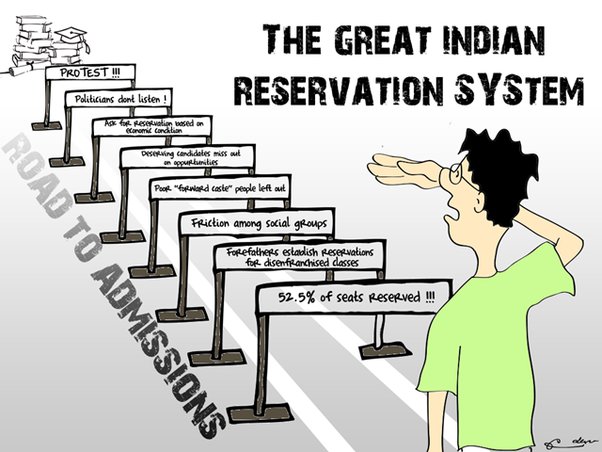
It has been quite common to hear from the upper castes that the reservation system hampers growth. They often argue that the system discriminates against them and say it doesn’t judge based on merit. Not just this, but a section criticises the Dalits for getting benefits through the reservation system.
In fact, on social media platforms such as Twitter, it has been a daily routine for this section of upper castes to ridicule the Dalits and call them “fools”, who got jobs only because of the reservation system that doesn’t reward “merit”. In this battle, this section of “upper castes” is accompanied by a section of non-resident Indians, who too routinely disparage this system. The strange argument put by this section is that this system is the root cause of casteism; so to remove casteism, they argue, the reservation system has to be removed first. This section ignores the very fact that this quota system has been introduced to address the social injustice caused by casteism.
Actually, the bitter truth is that this section of upper castes has been unable to digest the fact that the socially marginalised Dalits have been progressing well, thanks to the benefits of the quota system. Having said that, it is also a fact that a section of them are marginalised due to economic reasons. As a result, the Narendra Modi-led BJP government brought the Economically Weaker Section (EWS) quota through the 103rd Constitutional Amendment. Recently, the Supreme Court upheld the government’s decision of 10% reservation for people belonging to EWS for admission to educational institutions and government jobs. Obviously, many aren’t happy with this verdict as they view it against social justice.
Before the introduction of the EWS quota, there have been reservations for Scheduled Tribes, Scheduled Castes and Other Backward Castes. Still, some gaps remain to be addressed but it is no denying that the reservation system has benefitted these sections of society. Similarly, this EWS quota addresses the economically marginalised section of the forward castes. True, the forefathers of a large section of “upper castes” were superior in society but that can’t be the reason to ignore the marginalised section of this caste.
The argument that the EWS takes away the benefits of the SCs, STs and OBCs is quite exaggerated as their quota remains the same. Currently, there is 15%, 7.5% and 27% reservation for SCs, STs and OBCs respectively. EWS is an additional quota, and it doesn’t interfere with that prevailing. For a society to prosper, the marginalised sections need to be uplifted. And EWS aims to do precisely this and is a welcome step as it addresses one of the economic inequalities of society. It is wrong to vilify marginalised people from the forward castes. Unfortunately, for a section of Leftists and Liberals, it has been a daily routine to unnecessarily criticise all the people of the forward castes because of some of the wrong deeds done by a section of their forefathers.
Apart from this, due to EWS, the forward castes can no longer claim the reservation system discriminates against them. Many of them, who don’t use their caste to identify themselves and are habituated to calling Dalits, STs and OBCs “casteist”, today are going to benefit from the same reservation system they despised the most, only if they satisfied the criteria needed to come under the umbrella of EWS. Definitely, this strengthens the reservation system as now some of its fiercest critics are going to get benefits.
Coming down to sheer politics, it is estimated that the “upper castes” constitute around 25% of the country’s population. Currently, this section has been seen as the major vote bank of BJP, which too introduced this EWS quota to pacify the “upper castes” ahead of the 2019 Lok Sabha elections. Only a few months ago, it lost power in Madhya Pradesh, Rajasthan and Chhattisgarh to the Congress, and it was said that a major reason for the defeat was the growing dissent of the forward castes against the BJP. Importantly, the party didn’t waste any time and was quick to introduce the EWS quota, which was beneficial.
The Supreme Court verdict on EWS quota has been welcomed by most of the Opposition parties, including Congress and CPM. The latter has only expressed its concern about the criteria to decide the EWS quota. It believes the present Rs 8 lakh per annum and 5 acres of agricultural land would allow a large population, which is not poor, to access benefits of reservation and this would discriminate against the poorest of the poor. However, one of the Opposition parties opposing the EWS verdict is the ruling DMK in Tamil Nadu.
This speaks of the clout the “upper castes” enjoy in general among most political parties, which no longer are ready to ignore their issues. Remember, the Congress still has a committed vote bank among a section of the forward castes, particularly the Brahmins. And with the acceptance of the verdict the party has in a way pacified the anger of a section of “upper castes” that their interests don’t matter to any political party. Of course, the benefit of the reservation decision would in all likelihood pay off more for the BJP as it has maintained that the quota is aimed at empowering the EWS who don’t benefit from the caste-based reservation.
Lastly, there are concerns about the limit of reservations. This EWS exceeds the 50 per cent ceiling for reservations, however, in the end, their getting reservation should put an end to the bickering against the backward classes for bagging quota benefits. Nevertheless, there are drawbacks that remain within the reservation system that need attention for further reforms. A political consensus is thus critical, as the quota system did not give birth to the evils of casteism. Now that every caste is a beneficiary, the big question is whether the reservation debate will eventually end. Or will new demands from those ‘deserving’ and left out emerge? Remember, the reservation system opened the Pandora’s Box, and the lid may not be closed entirely. —INFA
