

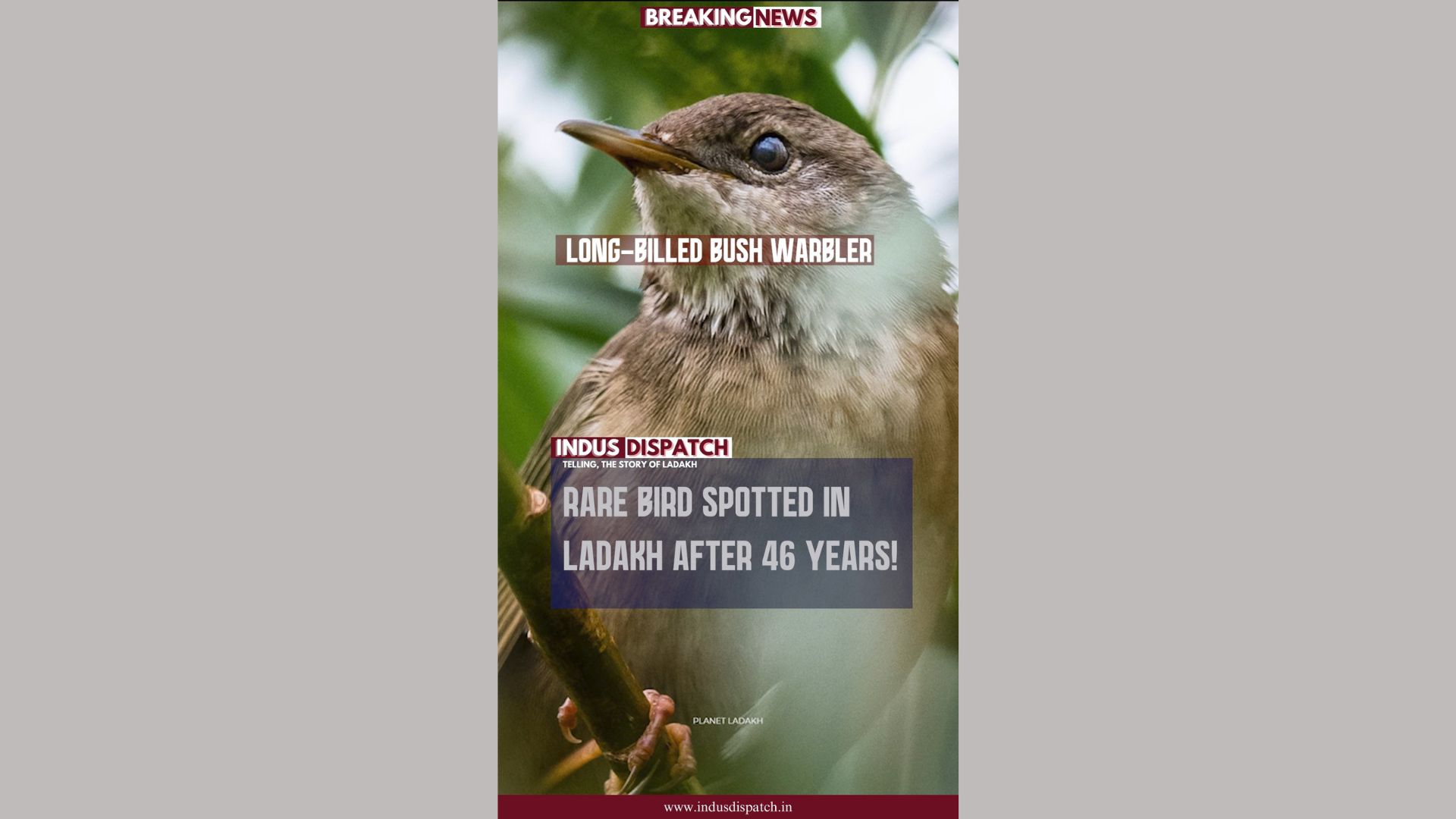
Leh: In a landmark discovery for India’s birding and conservation community, the elusive Long-billed Bush Warbler (Locustella major) has been officially sighted in Ladakh’s Suru Valley, marking its first confirmed sighting in India since 1979.
The rediscovery took place on July 15 at an altitude of 3,200 metres, near the village of Sankoo in Kargil district. A dedicated team of five birders—Harish Thangaraj, Lt Gen Bhupesh K. Goyal, Manjula Desai, Rigzin Nubu, and Irfan Jeelani—had specifically planned their expedition around this near-mythical species, often referred to as a ‘lost bird’ due to its vanishing presence over the decades.
Visual and audio evidence confirmed the bird’s presence after an insect-like “click-click-click” call led the group to a willow tree amid terraced fields. It is also the first recorded instance of the species being spotted in a willow habitat, expanding current understanding of its ecology.
“This is the highest altitude at which this bird has ever been recorded,” Harish Thangaraj told a national newspaper. “It also marks the first time we’ve seen the warbler in a willow tree, which now adds a new habitat to its record.”
The bird, listed as ‘Near Threatened’ by the IUCN, was last seen in India in 1979 by a group of birders from Southampton University. In the decades that followed, sightings became exceedingly rare, with only one more instance recorded—in Gilgit-Baltistan’s Naltar Valley in 2023 by ornithologist James Eaton, whose guidance later helped the Indian team narrow their search area.
The team’s initial efforts in the Gurez and Tulail valleys, between 2,400 and 2,800 meters, yielded no results, possibly due to altitude differences. Eaton’s inputs pointed them toward higher elevation and the right vegetation profile, ultimately leading to success in Suru Valley.
Lt Gen Bhupesh Goyal expressed hope that this rediscovery will “set the birding community aflutter” and inspire others to search for more of India’s forgotten avian species. The team now plans to continue its efforts to locate other long-lost birds.
Environmentalists and birding communities have hailed the rediscovery. Pankaj Gupta of the Delhi Bird Society, though not part of the expedition, called the sighting “nothing short of extraordinary,” noting it highlights how much remains hidden in India’s fragmented natural landscapes and the urgent need to protect such wilderness.
Celebrating the discovery, the Director General of Armed Forces Medical Services (DGAFMS) tweeted:
“In a significant milestone for Indian biodiversity, the Long-billed Bush Warbler, last documented in India in 1979 and considered lost, has been rediscovered in Suru Valley by a team led by Lt Gen Bhupesh K Goyal. This rare and remarkable sighting reflects the #IndianArmedForces’ dedication to environmental protection and wildlife conservation.”
In a significant milestone for Indian biodiversity, the Long-billed Bush Warbler, last documented sighting in India in 1979 and considered lost, has been rediscovered in Suru Valley by a team led by Lt Gen Bhupesh K Goyal, along with Shri Harish Thangaraj and three others. This… pic.twitter.com/6N6H4Vsdlo
— DGAFMS-MoD (@dgafms_mod) July 18, 2025
Once common in Ladakh and Gilgit-Baltistan in the early 20th century, the Long-billed Bush Warbler’s habitat has likely been altered by climate change and human expansion, pushing the species to higher altitudes. This rediscovery not only revives the species in India’s official bird records but also underscores the vital need to protect high-altitude ecosystems and promote responsible exploration of biodiversity-rich zones like Ladakh.
With this find, the song of the warbler echoes once more in the Himalayas—bringing with it a renewed sense of wonder, urgency, and hope.
