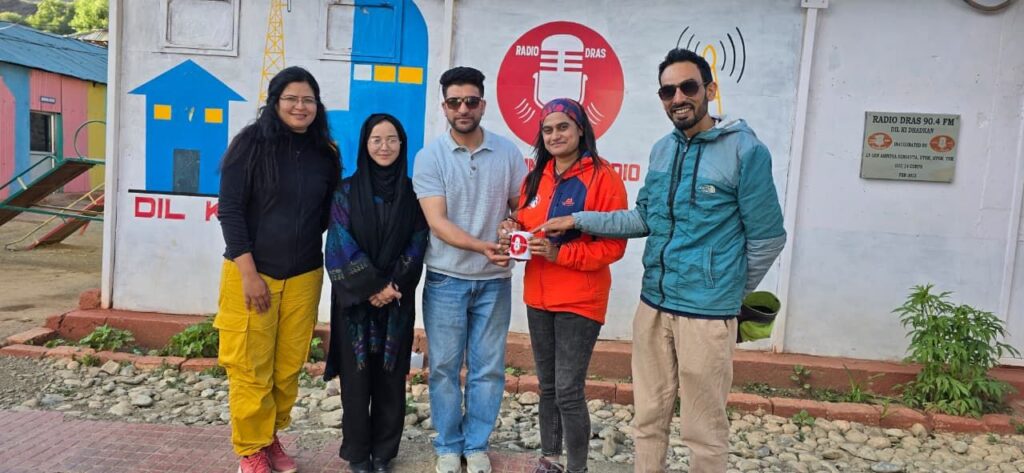
Drass, Ladakh: In a significant outreach initiative blending science, education, and community engagement, Community Radio Station Drass 90.4 FM hosted an interactive programme with researchers from Azim Premji University, Bengaluru, currently undertaking field investigations in the Drass region under the prestigious ISRO–NASA NISAR Mission.
The discussion shed light on the growing importance of the Himalayas in global climate research and highlighted emerging opportunities for students and local communities to participate in scientific studies and higher education.
Speaking during the programme, Dr. Remya S. N., Assistant Professor at the School of Climate Change and Sustainability, Azim Premji University, and Principal Investigator of the ISRO–NASA NISAR Project, described Drass as a crucial natural laboratory for studying permafrost, glaciers, rock glaciers, and climate change in the Western Himalayas.
She explained that the NISAR Mission—a landmark collaboration between ISRO and NASA—uses advanced satellite technology to monitor changes in the cryosphere, track landscape deformation, and assess the impacts of climate change across vulnerable mountain regions.
“Research in glaciology and cryosphere science is expanding rapidly, creating new opportunities for young scholars. Students from remote Himalayan regions have immense potential to contribute to these fields and become future leaders in climate research,” she noted.
Adding to the discussion, Dr. Manisha Mishra, Assistant Professor at the School of Climate Change and Sustainability and an expert in air pollution and atmospheric sciences, introduced listeners to the vision of the Azim Premji Foundation and Azim Premji University. She highlighted various academic programmes, scholarships, and career pathways available for aspiring students seeking to pursue higher education and research.
Providing a geological perspective, Dr. Ayas Muhammad Mir emphasized that Drass is among the most significant locations in the Himalayas for understanding geological and geomorphological processes. He spoke about the region’s unique mountain landscapes, landforms, and geological formations, describing them as valuable assets for future scientific exploration and environmental studies.
In her concluding remarks, Dr. Remya underscored the visible impacts of climate change on Himalayan glaciers, snow cover, and water resources. She urged young people to become more environmentally conscious and actively participate in climate action and sustainable practices.
She also expressed gratitude to Government Degree College (GDC) Drass, its Principal, faculty members, students, and residents of Drass village for their support during the field expedition to the Lasala Glacier. According to her, the collaboration between GDC Drass and the ISRO–NASA NISAR research team represents a significant step towards strengthening scientific research, education, and community participation in the Himalayan region.
The programme concluded with Station Head Mohd Saleem extending his appreciation to the research team from Azim Premji University for sharing their insights and inspiring local youth to explore careers in science, research, and environmental sustainability.