

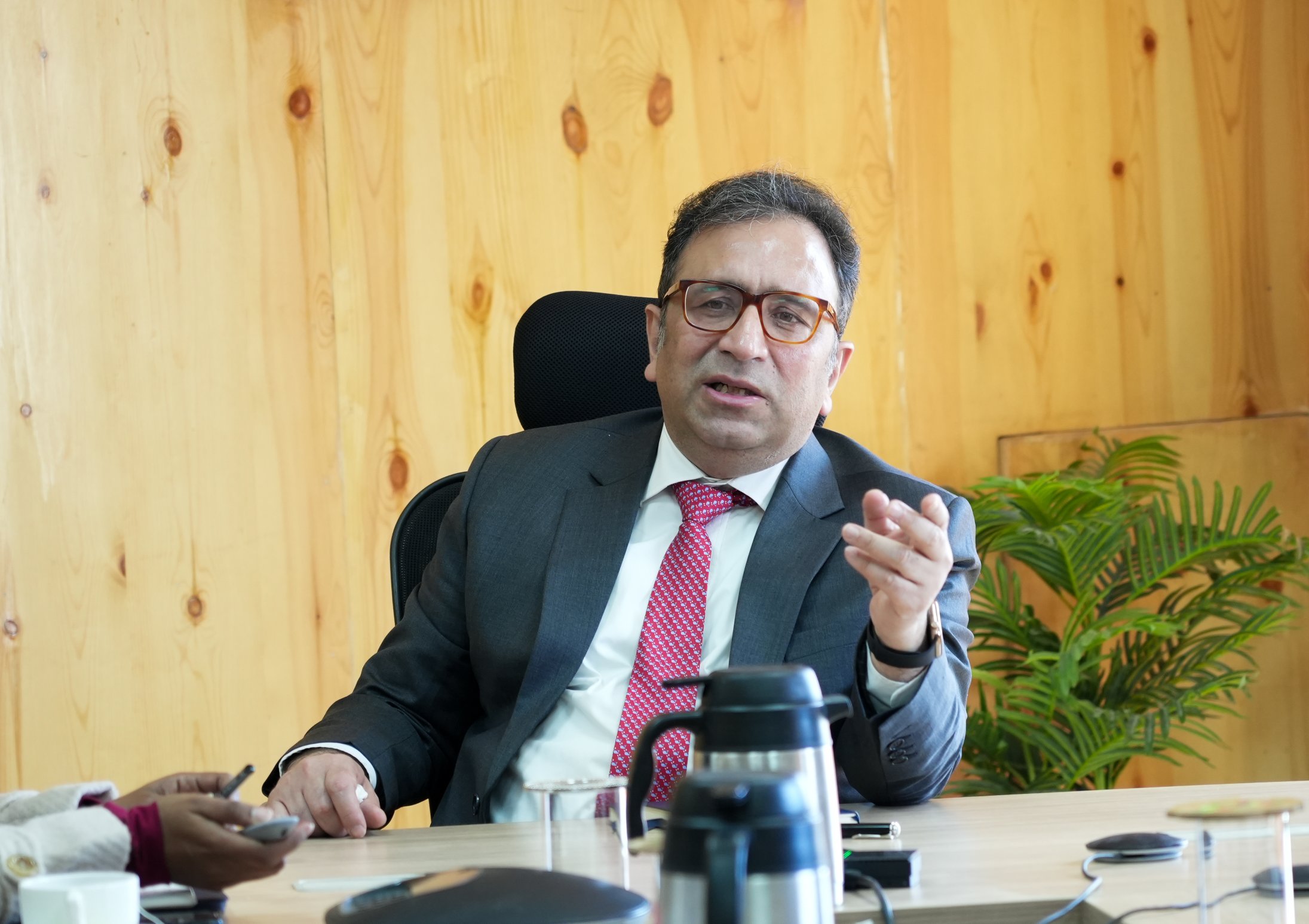
Leh : Ladakh has witnessed “unprecedented change” since becoming a Union Territory, with major improvements in infrastructure, public services and administrative outreach, Chief Secretary Ashish Kundra said in an interview with Indus Dispatch, while underlining that the region’s long-term future must carefully balance development, ecology and people’s aspirations.
Reflecting on his recent visits across Ladakh, Kundra said ground-level feedback from villages and remote areas points to visible progress, particularly in road construction, water supply schemes and electrification. He noted that electricity networks have expanded to far-flung areas and that power connectivity is expected to reach even up to the Siachen base camp this year. These investments, he said, have made daily life easier for residents.
He added that social sector infrastructure has also improved, citing upgrades in education and health facilities in both Leh and Kargil.
According to him, officials are working with commitment on the ground and there is a sense among many residents that Ladakh has moved onto a better development path after UT status.
Calling Ladakh a uniquely placed frontier region, Kundra highlighted its strategic location between Pakistan and China, as well as its distinct geography, culture and history. He said few places in India combine such strategic sensitivity with a unique civilisational and ecological profile. Because of this strategic importance, he noted, the Centre has a special focus on Ladakh.
At the same time, Kundra acknowledged concerns among locals about the possible environmental costs of rapid development.
He described Ladakh as an ecologically fragile region situated in the Himalayan belt, with glaciers, rivers, mountains and a sensitive climate system that require protection. Any development model for Ladakh, he said, must be environment-friendly and should not damage its natural heritage or unique wildlife.
He emphasised that Ladakh is still not at a stage where development has caused large-scale damage, but warned that maintaining a balance between growth and conservation is critical. The goal, he said, should be to pursue development without harming the environment.
On governance and decision-making, Kundra addressed the perception that decisions are sometimes taken far from the grassroots. He said clear instructions have been given to ensure there is no distance between the administration and the people.
Officials are being directed to remain accessible, hold regular public interactions and conduct field visits at least twice a month, with attention to both Leh and Kargil and special focus on remote and border villages. The message to residents, he said, should be that the administration is close to them and attentive to their needs.
Speaking about recent talks involving Ladakhi groups and the Centre, Kundra described the meetings as positive and held in an open, democratic atmosphere where all sides presented their views.
He said groups such as KDA and Leh-based representatives put forward political demands rooted in a desire for greater autonomous decision-making and protection of Ladakhis’ democratic rights and aspirations.
On the demand for Sixth Schedule safeguards, Kundra said central officials explained that the Sixth Schedule was originally designed for specific tribal-majority areas in the Northeast to protect minority tribes.
Applying it to an entire region like Ladakh, he indicated, is constitutionally and structurally complex.
However, he stressed that Ladakhi representatives were heard with an open mind and were encouraged to study other constitutional models.
He pointed to Article 371-type provisions as one possible framework among several that could be examined. The key principle, he said, is that any model must secure Ladakh’s future and be economically viable. The Centre’s view, according to Kundra, is that decisions should be taken with a 50-year perspective so that future generations do not feel that a wrong choice was made.
Kundra said the overarching aim is to find a model that protects Ladakh’s identity and aspirations while ensuring sustainable development and a secure economic future for the region.
