

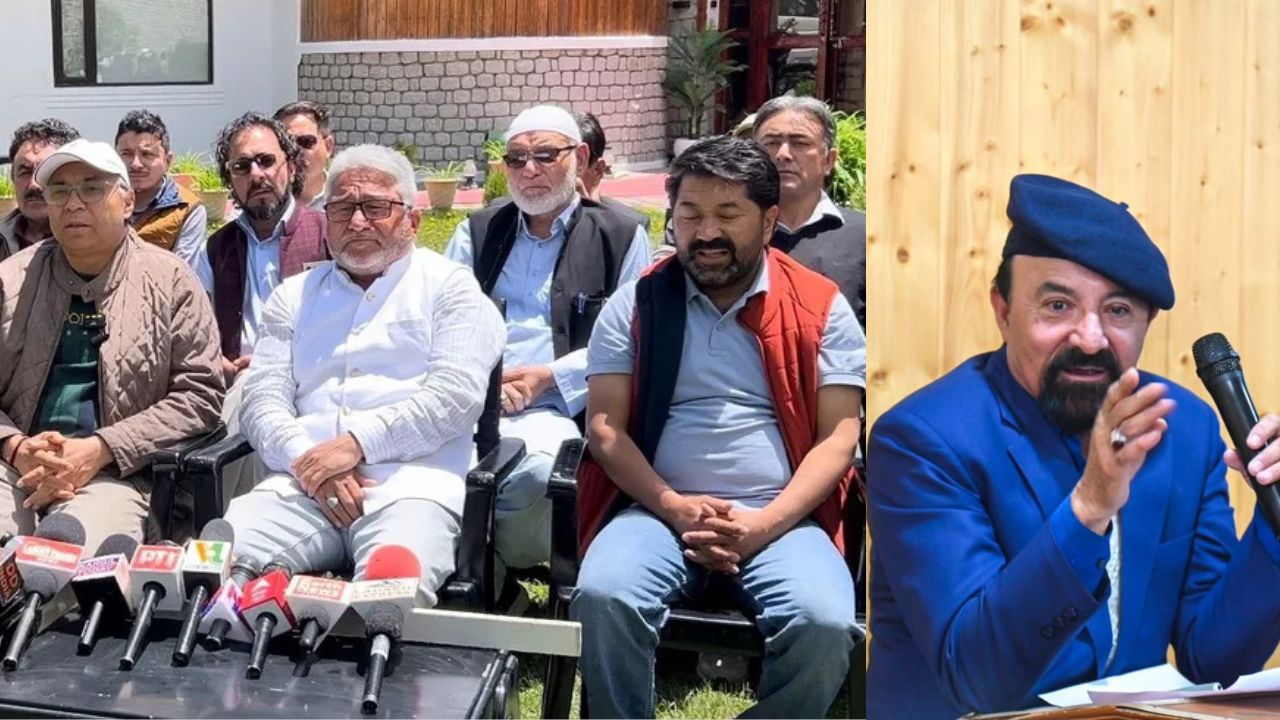
Kargil: A political crisis has erupted in the Ladakh Autonomous Hill Development Council-Kargil after Congress and the National Conference (NC) on Thursday announced a no-confidence motion against Chief Executive Councillor (CEC) Dr Mohd Jaffer Akhoon for refusing to step down after completing his agreed two-and-a-half-year term.
Addressing a press conference in Kargil, senior Congress leader Asgar Ali Karbalai said the Congress and NC had entered into a pre-poll alliance ahead of the 2023 LAHDC-Kargil elections under a rotational power-sharing arrangement.
“As per the memorandum of understanding signed between both parties, the five-year council term was to be shared equally, with each party holding power for two-and-a-half years,” Karbalai said.
Under the agreement, NC was allotted the post of CEC along with two Executive Councillor posts for the first half of the term, while Congress received two Executive Councillor positions. The arrangement, according to Congress leaders, ended on April 18, 2026, after which the CEC’s post was to be handed over to Congress.
Karbalai alleged that despite repeated requests from both Congress and the NC leadership, including NC president Farooq Abdullah, Dr Akhoon declined to resign, forcing the alliance partners to initiate a no-confidence motion.
“Eleven Congress councillors and five NC councillors have signed the motion,” he said, while asserting that the Congress-NC alliance remains intact.
Ladakh MP Mohmad Haneefa, who was also present at the press conference, said the council had functioned smoothly over the past two-and-a-half years despite administrative challenges following Ladakh’s Union Territory status.
“Since the CEC has not resigned as per the agreement, both parties have decided to move a no-confidence motion. Even a one-third majority was sufficient, but we are submitting it with a simple majority,” Haneefa said.
The NC had emerged as the single-largest party in the 2023 LAHDC-Kargil elections with 12 seats in the 30-member council, while Congress secured 10 seats. Together, the alliance commands 22 seats, comfortably above the majority mark. BJP had won two seats.
Unfazed by the development, Dr Akhoon maintained that he would not resign. He cited the recent creation of five new districts in Ladakh as a major administrative challenge requiring continuity in governance.
“I am not for politics but for development,” Akhoon said, adding that his focus remains on ensuring administrative stability during the ongoing transition.
The 2023 LAHDC-Kargil elections were politically significant as they were held after the abrogation of Abrogation of Article 370 and the reorganisation of Jammu & Kashmir and Ladakh into separate Union Territories in 2019.
Meanwhile, Chief Minister Omar Abdullah had earlier thanked Congress and the people of Kargil for supporting the NC-Congress alliance during the elections.
Ladakh currently has two autonomous hill councils — the Ladakh Autonomous Hill Development Council-Kargil and the Ladakh Autonomous Hill Development Council-Leh. The Leh council was established in 1995, while the Kargil council came into existence in 2003.
The political uncertainty also comes amid ongoing administrative restructuring in Ladakh following the Centre’s approval of five new districts in August 2024. Lieutenant Governor Vinai Kumar Saxena formally notified the new districts on April 26 this year, increasing the total number of districts in Ladakh to seven.
