

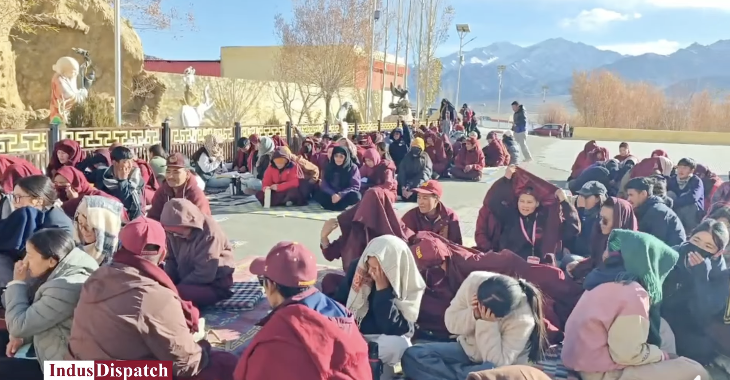
Leh: Students of the Central Institute of Buddhist Studies (CIBS), Leh, have called off their protest after receiving assurances from the institute’s administration and concerned authorities regarding long-pending academic and administrative issues — most importantly the non-recognition of Class 10 and 12 certificates issued by Sampurnanand Sanskrit University (SSU).
The issue, affecting several batches over many years, had triggered concern among students, who said that without recognition of these certificates they are unable to apply for higher education programmes, administrative subjects, or competitive examinations.
Speaking to Indus Dispatch, CIBS Student Welfare Committee President Tsering Kunzon said the authorities have assured the students that their certificates will be granted equivalence and that the process of finalising pending certificates is already 80% complete.
“They assured us that equivalence will be granted. They have said that within six months, the pending certifications will be finalised,” Kunzon said.
“We also raised that this issue should not be solved only for the current year but for all previous batches who have suffered.”
Students have been asking the authorities to create a separate board for CIBS, citing the unique nature of their curriculum which blends Buddhist philosophy, literature and language studies.
Kunzon said that depending on boards like CBSE or JKBOSE forces students to compromise with subjects that are not aligned with CIBS’ academic goals.
Kunzon added that CIBS was founded to preserve and promote Ladakh’s literary and philosophical heritage, and therefore students should not be made to adjust to administrative or curriculum structures that do not reflect this mandate.
CIBS Student Welfare Committee Vice President Lobzang Yangjor, speaking to Indus Dispatch, expressed serious concern over the institute’s proposal to recruit 30 professors under national reservation categories.
He said the adoption of the 13-point roster system could significantly reduce opportunities for Scheduled Tribe (ST) candidates — mostly local Ladakhi students and CIBS alumni — who form the core academic community the institute was originally meant to nurture.
“Applying national categories like OBC, SC, ST and UR without considering Ladakh’s unique social structure means local candidates may lose rightful representation,” Yangjor said.
He added that since CIBS is a Buddhist university dedicated to preserving and promoting Bhoti literature and Buddhist philosophy, proficiency in Bhoti language must be a mandatory eligibility criterion for relevant academic and administrative posts. Without this, he argued, the institute risks compromising its cultural integrity and academic continuity.
Yangjor said the student body has urged authorities to revise the recruitment model, prioritise Ladakh domicile candidates, and ensure fair representation for local ST scholars so that the institute continues to uphold its founding objectives and regional character.
A meeting was held between the Student Welfare Committee, the Board of Management members, the administration of CIBS, and representatives of the alumni association. Students say all issues — from certificate recognition to internal administrative challenges — were discussed in detail.
The administration reportedly assured continuous updates on the progress of certificate recognition and other student concerns.
Political activist and former parliamentary candidate Sajjad Kargili has also flagged the issue publicly, saying the non-recognition of certificates threatens the academic rights and future opportunities of hundreds of students.
He urged the Lieutenant Governor of Ladakh to take immediate cognisance.
The Central Institute of Buddhist Studies — formerly the School of Buddhist Philosophy — is a Deemed-to-be University under the Ministry of Culture. Founded in 1959, the institute was historically affiliated with the Sampurnanand Sanskrit University (SSU) in Varanasi.
It remains a premier institution for Buddhist studies in the Himalayan region.
