

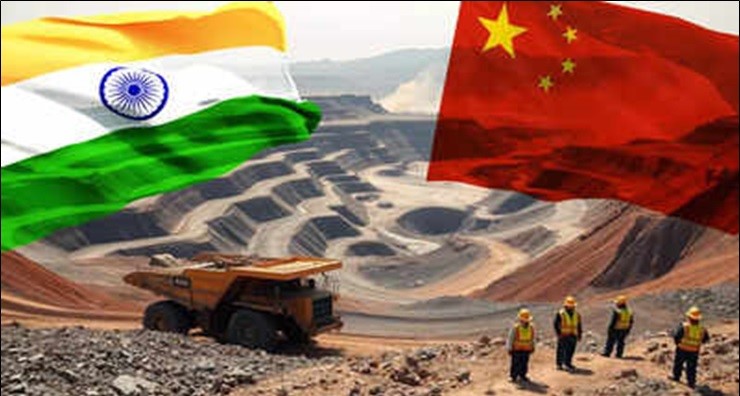
India’s Electric Vehicle (EV) industry stands at a precarious crossroads, as China’s abrupt export curbs on rare earth magnets threaten to bring domestic production lines to a halt. This move, widely viewed as economic coercion, highlights Beijing’s hypocrisy while China decries foreign restrictions, it leverages its near monopoly on these critical minerals to pressure nations like India, especially after India’s assertive stance in the defence sector dented China’s image.
With over 80% of India’s rare earth magnet imports sourced from China, the current deadlock exposes a strategic vulnerability. To secure its future, India must urgently diversify suppliers, incentivize domestic magnet manufacturing and accelerate R&D into alternatives, ensuring resilience against such geopolitical shocks.
According to the First Post, about India’s electric vehicle industry, It is facing a silent blockade from China. Production could come to a grinding halt, timelines could get impacted, all because of one small component. We are talking about rare earth magnets. What are these rare earth magnets? These are magnets made from special metals. They come from deep under the earth’s surface. They’re much stronger than your regular magnets. They’re used to make smaller machines and parts, which are then used in a wide range of products like electric vehicles or EVs. These magnets power EV motors. In wind turbines, they convert wind into electricity. They also go into phones and earphones and laptops and hard drives. So basically, these magnets are part of all modern machines, tools and their supply is almost entirely controlled by China. They’re hard to extract and expensive to process. China controls 70% of the mines, 70 and nearly 90% of the total production. In other words, China has a virtual monopoly and now it is using this dominance as leverage.
India’s automobile sector is grappling with continued supply disruptions due to China’s export restrictions on critical rare earth magnets despite nine Indian auto parts manufacturers receiving import endorsements from the Chinese embassy. These magnets are indispensable for electric vehicle production, particularly in gear systems and drive trains.
However, final approvals from China’s commerce ministry remain stalled. On 28 May 25, the Society of Indian Automobile Manufacturers (SIAM) made an urgent appeal to the Indian government, advocating bilateral talks to resolve the bottleneck and streamline China’s complex licensing process. Industry experts, including Saurabh Agarwal of EY India, emphasize that China’s tightening grip on strategic exports highlights the vulnerability of global supply chains and India’s pressing need for self-reliance.
Agarwal recommends immediate diplomatic engagement with China to ease short-term disruptions, while pushing for a targeted Production-Linked Incentive (PLI) scheme focused on rare earth magnets and mineral recycling to secure long-term resilience.
India is actively engaged in discussions with China to secure a steady supply of permanent magnets made from rare earth minerals, while also pursuing alternative supply avenues, commerce and industry minister Piyush Goyal stated.
Highlighting the strategic importance of these materials crucial for sectors such as automotive, consumer electronics, and white goods Goyal assured that the government is in constant coordination with domestic industry stakeholders to accelerate the development of indigenous capabilities.
He acknowledged the ongoing disruption caused by China’s export restrictions and confirmed that India’s embassy in Beijing is in regular contact with Chinese authorities. While some companies have submitted requests for export approvals, the minister expressed optimism about receiving positive responses. In parallel, the government is working closely with Indian Rare Earths Ltd to boost local extraction and processing capacities.
According to The Diplomat that Recognizing the risks, India has adopted a comprehensive strategy to secure its supply of rare earth minerals: –
Promoting Recycling and Circular Economy
India is ramping up efforts to recover REMs from end-of-life products, such as discarded electronics and batteries. The Ministry of Mines is designing incentive schemes to encourage recycling of critical minerals. While recycling is resource-intensive and requires robust logistics for e-waste collection, it offers a sustainable way to supplement primary supply.Investing in Domestic Production and R&D
The state-owned Indian Rare Earths Limited (IREL), established in 1950, is at the forefront of India’s
REE extraction and processing efforts. Recent milestones include the commissioning of a Rare Earth Permanent Magnet Plant in Visakhapatnam, which will produce samarium cobalt magnets using indigenous technology. This plant is expected to strengthen India’s domestic supply chain for high-performance magnets critical to EVs and renewable energy.
Diversifying Import Sources
India is actively seeking alternative suppliers to reduce its reliance on China. Kazakhstan has emerged as a promising partner, with rich REE reserves and established processing infrastructure. The two countries have a history of cooperation in trade, defense and civil nuclear energy, providing a strong foundation for collaboration in critical minerals. India is also exploring partnerships with other resource-rich countries and participating in international initiatives like the US-led Mineral Security Partnership.
Facilitating Regional and Global Collaboration
To foster a more resilient supply chain, India is engaging in regional initiatives such as the India Central Asia Rare Earths Forum (ICAREF). This platform aims to promote joint mining ventures and private sector investment, overcoming technical and logistical challenges to establish a regional REE market that benefits all participants.
India’s EV and tech industries face a critical test amid China’s calculated export curbs on rare earth magnets. While the disruption reveals India’s strategic vulnerability, it also serves as a wake-up call. By boosting domestic production, pursuing international partnerships and incentivizing recycling, India is laying the groundwork for long term resilience. China’s attempt to weaponized its mineral monopoly may backfire, as India accelerates efforts to decouple and assert economic independence in the global rare earth race.