

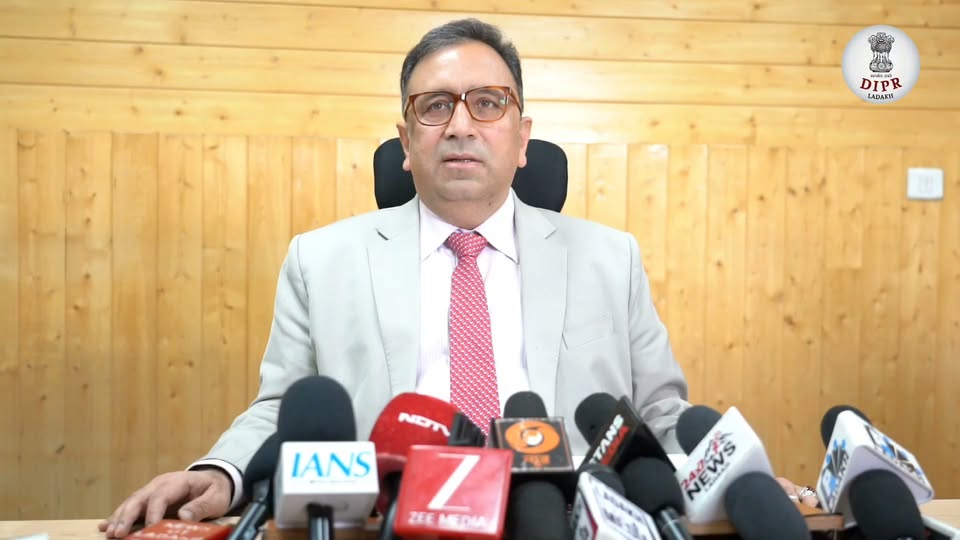
Leh: In a major move towards democratic decentralisation, the Ladakh administration has announced that Autonomous Hill Development Councils will be established in all seven districts of the Union Territory.
Chief Secretary Ashish Kundra said the decision had been taken in response to demands from regions including Sham, Nubra, Zanskar, Dras and Changthang for greater local representation and administrative empowerment.
He said Section 3(1) of the Ladakh Autonomous Hill Development Council Act provides for the establishment of an autonomous council in every district. Necessary legal amendments and delimitation of constituencies will now be undertaken to extend the council system across all seven districts.
The number of elected members in each council will be decided during the amendment and delimitation process, taking into account factors such as population, geographical area and local requirements.
The announcement marks a major expansion of elected grassroots governance in Ladakh, where difficult terrain, scattered settlements and long distances have often limited access to administration.
Ladakh-Specific Body Proposed Under Article 371
The Chief Secretary also announced that representatives of Ladakh and officials of the Central Government would begin drafting a framework for a Union Territory-level governing body under Article 371 of the Constitution.
The proposed institution is expected to possess legislative, executive, financial and administrative powers.
Kundra described it as a “customised model for Ladakh” that would incorporate suitable provisions and best practices rather than replicate an existing arrangement from another state or Union Territory.
He said discussions held by the sub-committee in Delhi on May 22 and in Leh on July 3 had taken place in a constructive and open atmosphere.
The final distribution of powers between the proposed UT-level body and the seven hill councils will be decided through constitutional and political negotiations. Their powers may be defined or rebalanced to ensure that the institutions function in coordination.
The proposed UT body is expected to provide representation at the Union Territory level, while the autonomous councils will focus on district and regional development.
## Panchayati Raj Institutions to Continue
The Chief Secretary clarified that the Panchayati Raj system would continue alongside the proposed councils and UT-level governing body.
He said village-level democracy remained essential and was constitutionally protected.
The emerging structure could therefore provide Ladakh with three layers of democratic representation: Panchayats at the village level, autonomous councils at the district level and a legislative body at the Union Territory level.
## Seven New Districts and 17 Tehsils Operationalised
Kundra said seven new districts had already been created in Ladakh as part of the administration’s effort to bring governance closer to remote communities.
The administration has also announced the establishment of 17 new tehsils. Posting orders for Tehsildars serving these tehsils have been issued.
New district-level posts will be created in consultation with the Ministry of Home Affairs. Until the process is completed, the administration will rationalise existing manpower to ensure that basic government services become operational in the newly created districts.
The Chief Secretary said the purpose of the restructuring was to reduce the need for residents of remote areas to travel long distances for administrative work.
Secretaries of different departments have also been directed to visit the new districts regularly and remain informed about local problems.
## New PWD, PMGSY and PHE Divisions
The Lieutenant Governor has ordered the creation of four new divisions for Public Health Engineering and Irrigation and Flood Control.
Seven new Public Works Department divisions will also be created, including five divisions for the Pradhan Mantri Gram Sadak Yojana.
Following the restructuring, each of Ladakh’s seven districts will have access to executive engineering officers for PWD, PMGSY and PHE or Irrigation-related works.
The Chief Secretary said the shortage of engineering officials in areas such as Dras and Zanskar had frequently delayed projects and forced residents to approach offices located far from their regions.
The new arrangement is expected to accelerate road construction, drinking water projects, irrigation works, flood-control measures and other public infrastructure programmes.
## Over 4,500 Recruitments Completed
Providing an update on government employment, Kundra said more than 4,500 recruitments had been completed in Ladakh since the formation of the Union Territory.
A total of 4,111 Group B and Group C non-gazetted posts have been filled. Results for another 473 posts have been declared and document verification is underway.
The administration has also completed 27 gazetted Group B recruitments, taking the overall number of completed appointments to more than 4,500.
Recruitment for 1,684 additional posts is currently underway.
These include 344 gazetted posts being processed through the Union Public Service Commission and 648 advertised non-gazetted posts.
The Education Department will advertise 262 posts for primary and upper-primary teachers, while the University of Ladakh is advertising 47 posts.
The administration will also advertise 40 Sub-Inspector posts, 331 Constable posts and 12 Fireman posts.
The Lieutenant Governor has directed the administration to approach the Ministry of Home Affairs for early approval to recruit feeder-cadre gazetted Group B officials.
The Departmental Promotion Committee process has also been accelerated by addressing delays related to vigilance clearances.
## Administration Reviewing Excise Policy Concerns
Responding to questions about the controversial Excise Policy, the Chief Secretary said the administration was taking note of public objections and local sentiments.
He said an appropriate decision would be taken after considering the concerns raised by the people.
## Casual Labour Cannot Replace Regular Recruitment
On the issue of casual labourers, Kundra said the administration could consider age relaxation and other permissible measures.
However, he maintained that casual appointments could not be treated as a substitute for a fair, transparent and regular recruitment system.
He said the interests of the younger generation and equal access to government employment had to be protected.
## Healthcare and Leh Development Initiatives
The administration has signed a memorandum of understanding with Mahabodhi Hospital to provide primary healthcare and treatment for high-altitude sickness.
The initiative is intended to reduce pressure on SNM Hospital.
The Chief Secretary also announced measures to improve Leh as the capital city of the Union Territory. These include addressing legacy land disputes, removing road encroachments to create space for pedestrians and shifting electricity wires underground in the Old Town.
The administration is also developing recreational and community spaces, including the forest reserve area at Choglamsar, to improve the cultural and aesthetic character of the city.
## A New Democratic Architecture for Ladakh
The creation of autonomous councils in all seven districts, alongside Panchayats and a proposed UT-level legislative institution, could give Ladakh one of the most decentralised systems of political representation in the country.
The final legal and constitutional framework is yet to be completed. However, the direction announced by the administration is clear: power, planning and public decision-making are to be taken closer to Ladakh’s districts, valleys, villages and border communities.
**For Ladakh’s remotest citizens, democracy will no longer remain concentrated in Leh and Kargil. It is now set to reach every district, every valley and every doorstep.**
