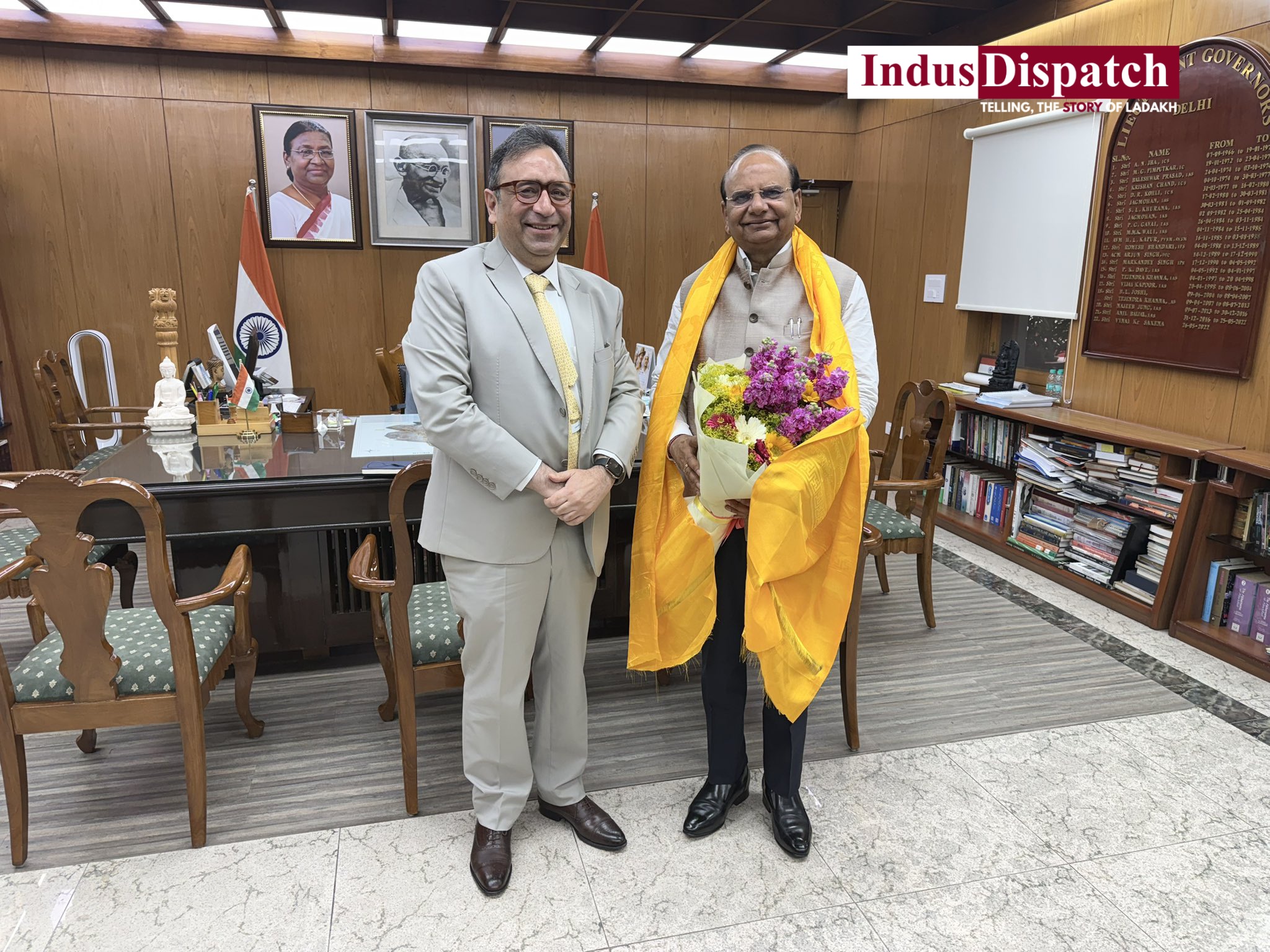
High in the cold desert of Ladakh, where governance often moves to the rhythm of weather, distance and delicate politics, an unexpected reunion is set to shape the Union Territory’s next chapter. When Vinai Kumar Saxena arrives in Leh to take oath as Ladakh’s fourth Lieutenant Governor on March 13, he will be greeted not merely by a new administrative landscape—but by a familiar and trusted colleague waiting at the helm of the civil administration.
That sense of familiarity was evident on Monday morning when Ladakh’s Chief Secretary, Ashish Kundra, formally welcomed the announcement on social media. “Formally welcomed Sh Vinai Kumar Saxena as the new Lieutenant Governor of Ladakh. A unique opportunity to work under his guidance once again!” Kundra wrote, hinting at the professional association the two administrators had forged earlier in Delhi.
Kundra, who assumed charge as Ladakh’s Chief Secretary on January 1, 2026, had earlier served for nearly two years as Principal Secretary to Saxena when the latter was Lieutenant Governor of Delhi. Within the corridors of Delhi’s bureaucracy, the Saxena–Kundra equation had come to be regarded as a particularly effective administrative partnership, one that quietly ensured coordination and continuity in an often politically turbulent environment.
Now that partnership appears set for an unexpected second act in the Himalayas.
The change comes amid a wider gubernatorial reshuffle by the Government of India. Ladakh’s outgoing Lieutenant Governor, Kavinder Gupta, has been elevated as Governor of Himachal Pradesh after a brief nine-month tenure in Leh—the shortest for any LG of the Union Territory. His successor, Saxena, brings with him a distinct administrative and political profile, and the Centre’s choice suggests a deliberate effort to place a trusted and experienced hand at the helm of Ladakh at a sensitive moment.
Since the Union Territory was carved out in 2019, Ladakh has witnessed a succession of administrators with varied backgrounds. R.K. Mathur, the inaugural Lieutenant Governor and a former Defence Secretary, was followed by Brigadier B.D. Mishra, an army veteran, and later Kavinder Gupta, a seasoned politician. Despite their diverse experience, one pattern remained striking: none completed even half of the five-year tenure envisioned for the office, each being recalled abruptly.
In this context, Saxena’s appointment appears to reflect the Centre’s continuing search for a stabilising figure capable of steering Ladakh through its evolving administrative and political demands.
Saxena’s own trajectory is unusual in India’s gubernatorial history. Rising from the corporate sector before entering public life, he is widely seen as someone who enjoys the confidence of Prime Minister Narendra Modi and maintains close access to Union Home Minister Amit Shah. Over the years, his activism—particularly during Modi’s tenure as Chief Minister of Gujarat—often aligned with the broader developmental vision of that administration. At times when infrastructure projects encountered resistance from civil society groups, Saxena’s interventions, frequently extending to legal challenges in courts, were credited with helping keep projects on course.
Before moving to Raj Niwas in Delhi, he served as Chairman of the Khadi and Village Industries Commission, where the organisation recorded the highest annual turnovers in its history.
For Ladakh, his arrival comes at a particularly significant juncture. The Union Territory is currently engaged in a sensitive dialogue with New Delhi over a fresh set of political and constitutional demands from local leadership. Managing that process will require both political credibility and administrative finesse.
In Leh, Saxena will find a ready partner in Chief Secretary Kundra. Over the past few months, Kundra has quietly consolidated administrative authority and built a measure of confidence among Ladakhi stakeholders. The prospect of the two officials working together again—this time in a far more demanding and strategically important setting—has already sparked quiet optimism within bureaucratic and political circles.
If Delhi provided the proving ground for the Saxena–Kundra administrative chemistry, Ladakh may well become the stage where that partnership is tested in its most consequential form yet. For the high-altitude Union Territory navigating its young and evolving governance, this reunion could prove more than symbolic—it may shape the tone of Ladakh’s next phase of peace, stability and development.
A Reunion in Ladakh: Saxena and Kundra Begin Their Second Act in the High Himalayas