

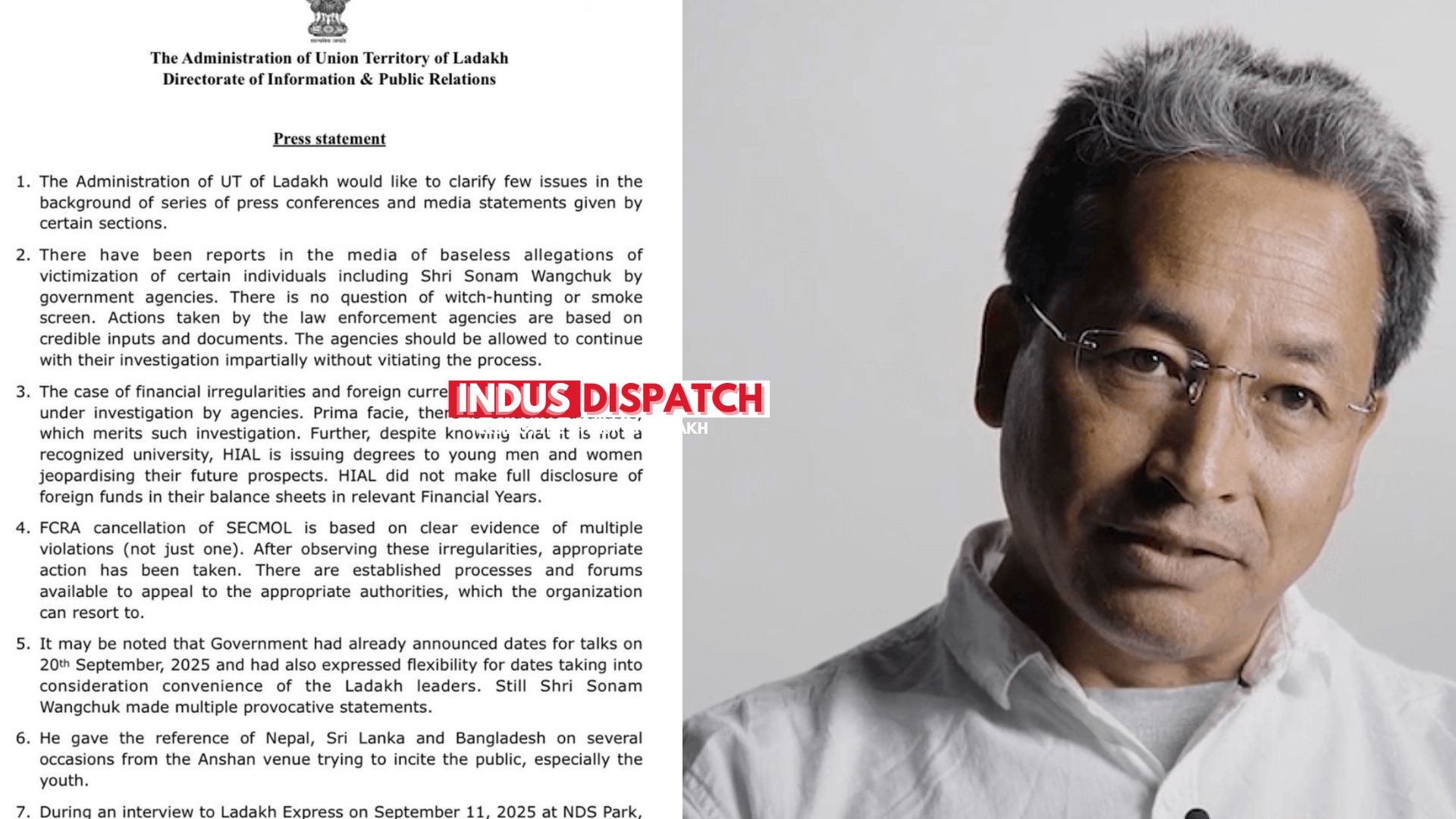
Leh: The Administration of the Union Territory of Ladakh has issued a detailed clarification in response to a spate of press conferences and media statements, rejecting allegations of victimization of educationist Sonam Wangchuk and asserting that law enforcement agencies are acting on credible evidence.
Officials dismissed claims of “witch-hunting” against Wangchuk and his institutions, stressing that ongoing investigations into financial irregularities and foreign currency violations are based on documents and inputs.
“Agencies should be allowed to continue with their work impartially without vitiating the process,” the statement said.
According to the administration, the Himalayan Institute of Alternatives Ladakh (HIAL) is under probe for foreign exchange violations and financial discrepancies. Prima facie evidence, it said, shows that HIAL issued degrees despite not being a recognized university, jeopardising students’ futures. Investigators also found incomplete disclosure of foreign funds in its balance sheets.
The government further noted that the Foreign Contribution Regulation Act (FCRA) registration of SECMOL was cancelled after “multiple violations” were observed, not on the basis of a single infraction.
The administration underlined that legal forums are available for the organization to appeal the decision.
On the political front, the statement accused Wangchuk of making provocative remarks despite the government announcing September 20, 2025, as the date for the next round of talks with Ladakhi leaders.
Authorities claimed Wangchuk referred to Nepal, Sri Lanka, and Bangladesh during his Anshan to incite youth and, in a September 11 interview with Ladakh Express, suggested that young people rejected peace and Gandhian methods.
The administration alleged that ahead of his fast, Wangchuk urged protesters to wear masks, caps, and hoodies “citing COVID as an excuse” despite there being no signs of the virus in Ladakh. It also cited a June 8, 2025, video on his YouTube channel Achoe Nyingstam, in which he purportedly spoke of triggering an “Arab Spring–type revolution” to overthrow the government.
The statement accused Wangchuk of repeatedly hinting at self-immolation as a protest tool, drawing parallels with Tibet and Arab countries, and of failing to pacify an aggressive crowd even as other All Buddhist Leaders (ABL) elders tried to calm the situation. Authorities claimed that when the protest spiralled out of control, Wangchuk discreetly left the Anshan venue, “indicating irresponsibility.”
Despite the government’s offer of talks, the administration said, Wangchuk continued his hunger strike for “personal and political gain,” which it blamed for the escalation of unrest in Leh. Grounds of his detention, officials added, were duly served to him.
The administration concluded by appealing for peace, urging the public to allow the law to take its course. “We are confident that together we will bring back normalcy in the peace-loving Leh Township and continue with our dialogue process,” it stated.
