

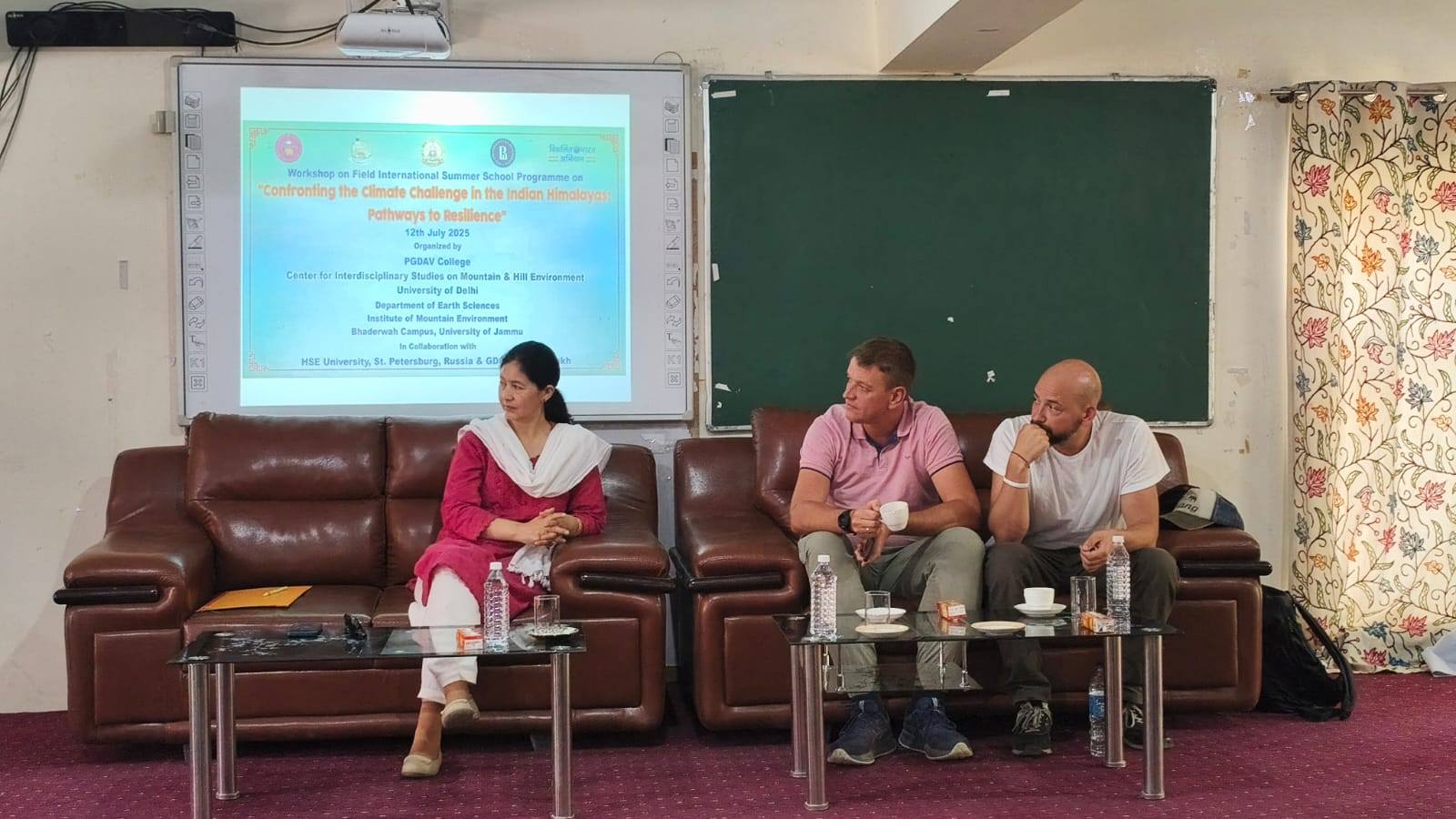
Kargil : In an effort to address one of the most pressing global issues of our time, Government Degree College (GDC) Kargil organized an interactive session titled “Confronting the Climate Change in the Indian Himalayas: Pathways to Resilience” on Saturday. The event was held in collaboration with HSE University, St. Petersburg (Russia), PGDAV College, University of Delhi, and the Bhaderwah Campus of Jammu University.
The seminar, held in the college’s seminar hall, brought together academicians, researchers, and students to explore region-specific strategies for combating climate change, with a focus on Himalayan ecosystems.
Welcoming the esteemed guests, Principal Disket Angmo noted that Ladakh stands at the frontlines of climate change, defined by the resilience of its mountains, ecosystems, and most importantly, its people. She emphasized GDC Kargil’s commitment to fostering sustainability and collaborative learning grounded in the region’s unique environmental realities.
Dr. Tsering Tundup, the Organising Secretary of the summer school program, opened the session with an introductory speech, setting the stage for an engaging academic exchange. Dr. Pradeep Singh, the Convener, urged participants to look beyond theoretical definitions and adopt practical, localized solutions to climate issues. He encouraged students to “think beyond the textbook” and apply innovative thinking to micro-level environmental problems.
International perspectives were brought to the forum by Prof. Alexander Sorokin, Dean of Social Sciences at HSE University, St. Petersburg. He presented a comparative analysis of the Altai region of Russia and Ladakh, highlighting ecological challenges, cultural similarities, and environmental conflicts. He stressed the importance of reviving traditional knowledge systems to support sustainable development and global research.
Dr. Fayaz Ahmed Kacho, Research Scholar at the University of St. Andrews (Scotland), advocated for reintegrating traditional practices into daily life to bolster resilience. He emphasized that such practices should be embraced, not abandoned, in the era of climate crisis.
Dr. Richa Agarwal from PGDAV College, University of Delhi, echoed similar sentiments, encouraging students to find local economic and entrepreneurial solutions that align with the fragile ecosystem of Ladakh. She highlighted the importance of community-based efforts in preserving environmental balance.
Sharing his experience as a student participant, Mr. Egor Petrov, a Naval Architecture graduate attending the summer school, reflected on the rich learning and cultural exchange he gained through the visit.
The event saw the participation of around 100 students and concluded with an interactive Q&A session, where students engaged directly with the speakers. A heartfelt vote of thanks was delivered by Sakina Mehak, a first-semester student.
Mr. Mohammad Ali Shabir, Assistant Professor of English at GDC Kargil, coordinated the event alongside various college committees, ensuring smooth organization and meaningful dialogue throughout the session.
The program not only enriched students’ understanding of climate challenges in high-altitude regions like Ladakh but also strengthened international academic collaboration in the search for sustainable, localized solutions.
