

LEH: The Centre has decided to upgrade security at scientific and technical installations located in the border regions of Jammu and Kashmir, Punjab, Chandigarh, and parts of Rajasthan and Gujarat.
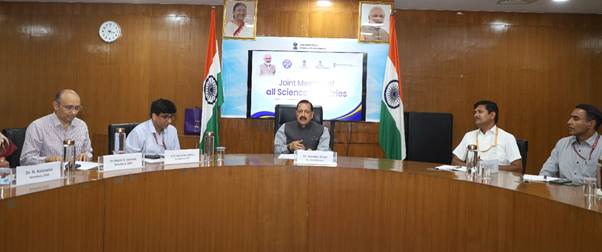
The decision was announced on Saturday by Union Minister of State for Science and Technology, Dr. Jitendra Singh, after he chaired a high-level joint meeting with senior officials and heads of scientific institutions in New Delhi.
The meeting was convened to review the security preparedness of critical scientific infrastructure across the country, particularly in sensitive border zones. The minister also focused on internal readiness and civil coordination at these facilities.
Dr. Singh conducted a detailed review of security mechanisms at key institutions including CSIR-Indian Institute of Integrative Medicine, Jammu; CSIR-Central Scientific Instruments Organisation and CSIR-Institute of Microbial Technology, Chandigarh; CLRI, Jalandhar; NABI, Mohali; and Earth Sciences installations in Ladakh. He also directed special attention to IMD facilities in Srinagar and Leh, instructing the Director General of IMD to enhance security at these locations.
Recognising the national importance of these scientific establishments, the minister said that such institutions form the backbone of India’s research and disaster response infrastructure. All scientific departments have been asked to upgrade their security protocols and maintain close coordination with local district administrations.
Each institution has also been directed to issue updated Standard Operating Procedures for emergency response, conduct mock drills, and organize sensitisation programmes on self-defence and evacuation strategies. Dr. Singh further advised postponement of examinations and research proposal deadlines to accommodate students and researchers affected by the situation.
He emphasised that India’s scientific institutions must remain prepared and resilient, and highlighted the importance of morale-building efforts and continuous communication with local authorities.
Dr. Jitendra Singh specifically reviewed preparedness and security mechanisms at CSIR-Indian Institute of Integrative Medicine (IIIM), Jammu ; CSIR-Central Scientific Instruments Organisation (CSIO), Chandigarh; CSIR-Central Leather Research Institute (CLRI), Jalandhar; CSIR-Institute of Microbial Technology (IMTECH), Chandigarh; DBT-Biotech Research Innovation Council (BRIC) – National Agri-Food and Biomanufacturing Institute (NABI), Mohali; Indian Meteorological Department (IMD) Installations in Srinagar and other key areas; Earth Sciences Research Stations in Ladakh and surrounding zones.
Recognizing the strategic importance of these institutions, Dr. Jitendra Singh emphasized that scientific facilities, especially those under the Council of Scientific and Industrial Research (CSIR), Department of Biotechnology (DBT), Indian Meteorological Department (IMD), and Ministry of Earth Sciences, are key pillars of national infrastructure, particularly in the fields of weather forecasting, disaster preparedness, and critical research.
All scientific institutions have been directed to review and enhance their current security protocols in the light of the prevailing situation. They must immediately inform the respective district administrations to ensure seamless coordination and protection.
Additionally, each institution is required to develop and circulate Standard Operating Procedures (SOPs) for emergency response, ensuring that both staff and local authorities are well-prepared. To avoid disadvantaging students and researchers who may have returned to their home states, all upcoming examinations and research proposal calls are to be postponed until further notice.
