


LEH: On a hot June afternoon in the year 2022, Union Home Minister Amit Shah had sought to simmer down the rising mercury in Ladakh agreeing to grant Constitutional protection to the union territory under Article 371 of the Constitution.
In first direct contact with the Leh Apex Body (LAB), leading the agitation from Leh over demands that included Statehood and Ladakh’s inclusion into the sixth schedule, Shah had held one-to-one meeting with LAB chairman Thupstan Chhewang and told him while Statehood was not a bright possibility, the MHA was open to give ‘Sixth Schedule-like’ Constitutional protection to Ladakh under Article 371.
Twenty months later, a period which witnessed multiple protests in Leh and Kargil, Jammu and New Delhi, change of guard at Raj Niwas, multiple climate fasts by activist Sonam Wangchuk, and constitution and reconstitution of High-Powered Committee, followed by a Joint Sub-Committee, things are back to square one for Ladakh.
In a meeting with the leaders of Leh Apex Body and Kargil Democratic Alliance held in North Block Monday evening, Shah was clear in his words, as he was 20 months ago– Sixth Schedule is not a possibility, as he reiterated that constitutional safeguards akin to those granted under Article 371 are still on the table.
If sources are to be believed, the MHA is open to provide protection for culture, language, land and jobs-as demanded by the people and leaders of Ladakh, but not in the way that representatives seek—under Sixth Schedule.
“Shah acknowledged the concerns of the people on land, jobs, language and culture, and assured that all these concerns can be addressed through special provisions under Article 371 of the Constitution,” a source informed Indus Dispatch.
Sixth Schedule & Article 371
The sixth schedule is a special provision provided under Article 244(2) and Article 275(1) of the Constitution, that provides for the administration of tribal areas in Assam, Meghalaya, Tripura and Mizoram to safeguard the rights of the tribal population in these states. This provision seeks to do so through the formation of Autonomous District Councils (ADCs) and Autonomous Regional Councils (ARCs), armed with certain legislative, judicial, executive and financial powers.
These councils can make laws on certain specified matters like land, forests, canal water, shifting cultivation, village administration, inheritance of property, marriage and divorce, social customs and so on, but having no effect until assented by the Governor of the State. These councils can establish, construct or manage primary schools, dispensaries, markets, cattle ponds, fisheries, roads, road transport and waterways in the respective districts; to form courts to hear cases pertaining to members of Scheduled Tribes with maximum sentence less than 5 years; to levy taxes, fees and tolls on buildings, land, animals, vehicles, boats, entry of goods into the area, roads, ferries, bridges, employment and income and general taxes for the maintenance of schools and roads, and to grant licences or leases for the extraction of minerals within their jurisdiction.
However, the Sixth schedule is a special provision, introduced and amended from time to time, only to include certain areas–not the entire region or state– of only four states. In all, there are only 10 areas in the Northeast that are registered as autonomous districts – three in Assam, Meghalaya and Mizoram and one in Tripura.
Then, there is Article 371
Articles 371 and 371-A,B,C,D,E,F,G,H,I and J, provide special provisions for specific states, often to give representation to certain religious and social groups and to allow these groups to exercise autonomy over their affairs without interference from the state and central governments.
The Special provisions under Article 371 would allow protections to be extended to the local population of the region, in this case Ladakh, while stopping just short of the widespread autonomy that is provided to ADCs and ARCs under the Sixth Schedule.
As of now, Article 371 applies to a dozen states including six in the North East. The states are Maharashtra, Andhra Pradesh, Gujarat, Telangana, Sikkim, Mizoram, Arunachal Pradesh, Assam, Nagaland, Goa, Manipur and Karnataka.
These provisions were added to the Constitution keeping in mind ‘special circumstances’ of individual states and they specify a multitude of protections for each state given their unique requirements.
Other Demands
In Monday meeting, Shah also assured the delegation comprising of Thupstan Chhewang, Chering Dorjay Lakruk and Nawang Rigzin Jora, representing the LAB, and Qamar Ali Akhoon, Asgar Ali Karbalai and Sajjad Kargili, representing the KDA, of strengthening the representation and participation of the local people through the existing all-powerful hill councils of Leh and Kargil.
Indus Dispatch has extensively reported in the past that the government is actively considering enhancing the powers and budgets of the two hill councils, and Shah in Monday meeting asserted the same.
“Their budget would be as good as a state’s budget,” a source quoted Shah telling the delegation, adding that the Centre was ready for reserving every 4 of 5 jobs in Ladakh for the locals.
Ladakh back to Square One
However, the LAB and KDA leaders, soon after leaving from Shah’s residence issued a statement saying the meeting “too didn’t result in any positive outcome” and that the two groups leading the agitation would “consult with the people of Ladakh to devise a future course of action”.
On Tuesday, the religious organisations in Leh called for a ‘Ladakh Bandh’ to be observed on Wednesday in the support of ABL and Leh, while extending their support to social activist Sonam Wangchuk’s indefinite climate fast.

“As our leaders said that nothing positive came out in Monday’s joint sub-committee meeting and their subsequent meeting with Home Minister Amit Shah, the talks for now are stalled. As the matter is related to our future, and the future of Ladakh, all religious and community leaders have unanimously decided that Ladakh would be shut down on Wednesday,” they told the media on Tuesday.
However, the Merchant Association boycotted the ‘Ladakh Bandh’ call citing indifference on the time & scheduling for the Bandh call.
A Bandh & A Fast
Ground reports say that around five-six thousand people gathered on the streets of Leh on Wednesday, which while being a far cry from participation of 30-odd thousand in February 3 Bandh, is still a huge number.
Thousands of men and women came out on streets as Leh observed a strike on Wednesday in support of Ladakh’s inclusion into the 6th schedule and grant of Statehood to the union territory, even as noted social activist Sonam Wangchuk also commenced his climate fast in support of the Leh Apex Body and the Kargil Democratic Alliance, the two socio-political organisations leading the protest over the demands.
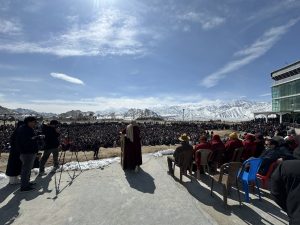
All shops and business establishments remained closed, with Sonam Wangchuk and LAB co-chairman Chering Dorjey Lakruk addressing the gathering at NDS Stadium after which Wangchuk started his indefinite fast.
Addressing the gathering, Wangchuk said that the Union Government still has the chance to fulfill its promises made to the people of Ladakh. He said that the fast will be indefinite, and will see rotation after every 21 days, till the demands of Ladakh are met.
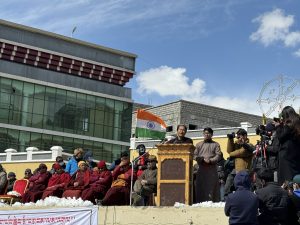
Lakruk said that the deadlock in the ongoing talks with the MHA prevailed on the demands of Statehood and 6th Schedule. “The MHA wanted to implement some parts of the 6th Schedule indirectly, while we insisted on its direct implementation besides the restoration of Statehood,” he said.
