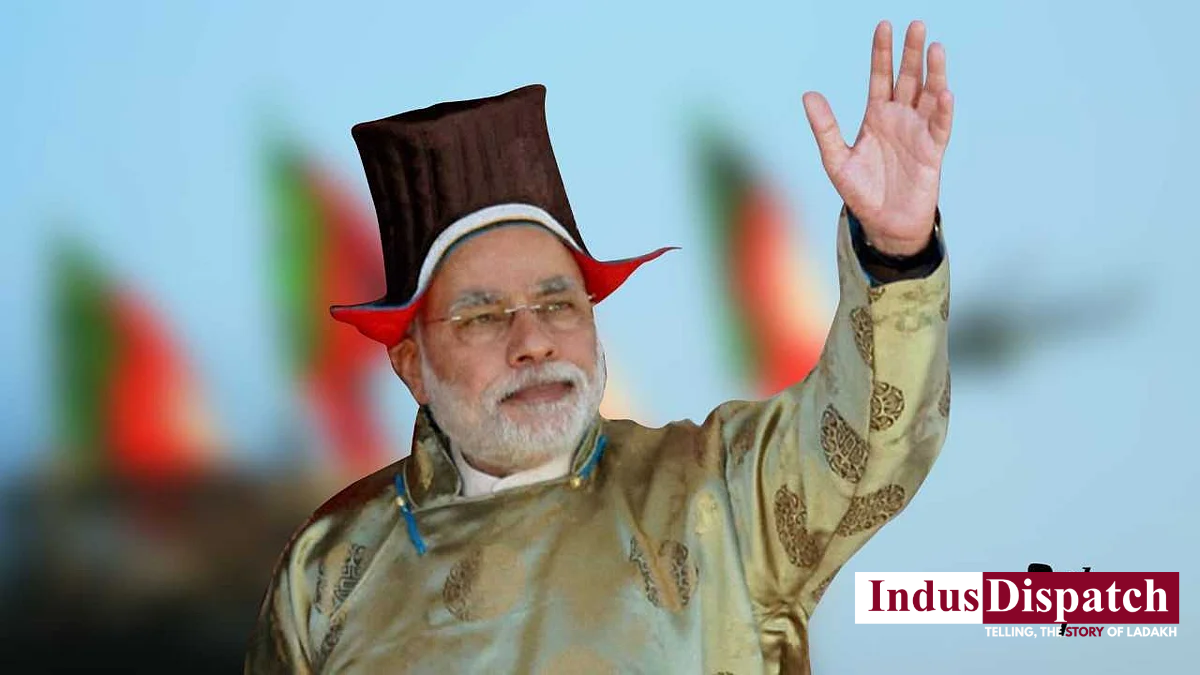
LEH, September 10: Prime Minister Narendra Modi is expected to visit Ladakh later this month, a possible visit that comes amid a series of measures by the Centre and the Union Territory administration aimed at addressing long-standing political and developmental concerns in the region.
Minority Affairs Minister Kiren Rijiju, during his recent visit to Ladakh, had also indicated that the Prime Minister was likely to visit the Union Territory.
The visit, if it takes place, could acquire significance beyond its immediate itinerary. It comes at a time when the Centre and Ladakh are discussing a new political and constitutional framework for the Union Territory, even as a series of confidence-building measures have been announced in recent months.
The emerging approach envisages Ladakh continuing as a Union Territory, retaining the Centre’s direct role in funding and development, while strengthening elected institutions and local autonomy.
The administration has already announced the extension of the Ladakh Autonomous Hill Development Council system to all seven districts of the Union Territory. Ladakh, which had only Leh and Kargil as its districts, now has five additional districts — Sham, Nubra, Changthang, Zanskar and Drass.
The proposed governance architecture also includes a UT-level elected body under a customised Article 371 framework. Current discussions between Ladakh representatives and the Centre are considering enhanced safeguards for land, employment, culture and local governance. The precise powers and constitutional provisions, however, are still being negotiated.
Against this political backdrop, Modi’s possible visit is also expected to take him to Chumur, a remote settlement close to the Line of Actual Control, where the government is developing Ladakh’s first Model Border Village under the Vibrant Villages Programme.
Situated at an altitude of about 16,700 feet, Chumur has just 24 households and a population of 91. Its residents are primarily engaged in Pashmina goat rearing and wool production. The village is also part of the Korzok-Hanle tourism circuit.
The Model Border Village project is intended to combine infrastructure development with employment, livelihood generation, tourism and all-weather functionality.
Under the plan, families will receive climate-resilient, south-facing passive-solar houses designed for the extreme winter conditions of the region. Each house will include an attached bathroom, an additional room that can be used for homestay activities, kitchen-garden space, livestock sheds and fodder storage.
Chumur is the first of 10 border villages planned to be developed as Model Border Villages in the first phase of the programme.
For Modi, a visit to Chumur would therefore bring together two strands of the government’s evolving Ladakh policy: greater political accommodation at the institutional level and accelerated development at the region’s remote frontier.
It would also be Modi’s first reported visit to the LAC in Ladakh since his unannounced visit to Nimu in July 2020, shortly after the Galwan clash. He had subsequently visited Drass and Leh in July 2024, but did not travel to the LAC.
The significance of the proposed visit, therefore, may lie as much in its political message as in its location: Ladakh is increasingly being presented not merely as a sensitive frontier, but as a region requiring a distinctive model of governance, development and local participation.
Amid major political, governance push, PM Modi visiting Ladakh this month