

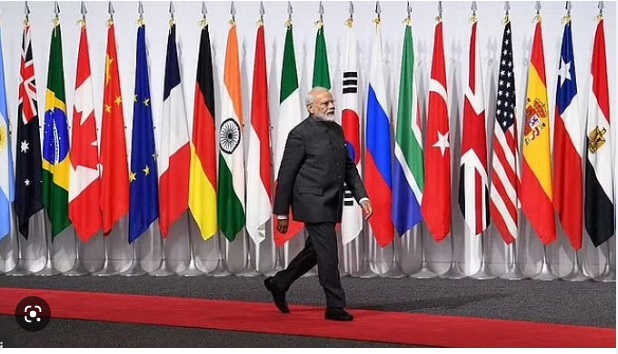
In the G-20 Summit at Bali, India will be handed over the presidency of the most powerful economic group and will host the 18th summit next year. As is his wont, Prime Minister Narendra Modi will add an Indian flavour to the summit. He did say so while taking off to Bali to participate in the summit, “India’s G-20 presidency will be grounded in the theme, vasudheva kutumbakam (world is family), or One earth, One family, One future”. This underlines the message of equitable growth and shared future for all. It is, indeed, a powerful line of emotive thinking.
India may transmit such a message to the world body, as Swami Vivekananda did in his iconic speech on 11 September 1893, to “world’s parliament of religions”, at Chicago. His address to Americans as sisters andbrothers shook as well as touched their hearts. However, the moot point is how much India benefits economically from Modi’s leadership of G-20 for a year?
G-20 consists of strong economies of the world, represents 85 per cent of the global GDP, 75 per cent of the global trade and 66 per cent of the world population. It began as G-7 in 1970s in response to the spikes in prevailing food and fuel prices. It came to be known as G-8 when Russia joined it in 1996. However, in the late 1990s, the financial crises affected a number of emerging economies in Latin America and Asia, threatening to spill over G-8 countries. That is when the G-8 countries began to expand to include other countries. After some experimentation, a solid grouping of 20 countries, G-20 was created in 1999 that included countries from global South to make it more inclusive and egalitarian. This group was a great improvement on elitist G-8, and different from the unwieldy 38-member OECD — Organisation of Economic Cooperation and Development.
Now, the G-20 comprises Argentina, Australia, Brazil, Canada, China, France, Germany, India, Indonesia, Italy, Japan, South Korea, Mexico, Russia, Saudi Arabia, South Africa, Turkey, the UK, the US and the European Union. Spain is a permanent invitee. In addition, the special invitees are called in its summit. This year, the invitees include Cambodia, Fiji, Netherlands, Rwanda, Senegal, Singapore, Suriname and the UAE. Also heads of several international agencies and regional bodies attend the summits. In Bali, those attending are UN, IMF, ASEAN and the African Union. The Indonesian President Joko Widodo (Jokowi) has also invited the Ukrainian President Zelenskyy to address the summit virtually.
There is a troika of leadership consisting of the past president of G-20, the current and the future. For now, the troika is made by Italy, Indonesia and India. The next one will consist of Indonesia, India and Brazil, marking the transition of leadership from North to the South. Note that the summit is a combination of several ministerial meetings and working groups that have been at work for the past one year in the key priority areas, in the run-up to the summit.
The slogan of the Bali summit was ‘recover together and recover stronger’. It comprised three sessions: food and energy security, health partnerships for global infrastructure, and investment and digital transformation. Besides these working sessions, the G-20 leaders discussed key issues of global economy, environment, climate change and agriculture. To highlight the concerns about the climate change, President Jokowi invited and escorted his guests to the Indonesian mangroves and planted mangroves at the Ngurah Rai forest park; mangroves act as bio-shields against extreme climate change.
The summit took place against a backdrop which was neither desirable nor conducive to world peace, progress and security. The challenges in the environment, especially that of climate change, lack of progress in the sustainable development goals (SDGs), and the perilous impact of Covid pandemic, the struggle for economic recovery, debt vulnerabilities, and to top it all, the ongoing war in Ukraine and its tragic consequences on food and energy security and inflation etc. The joint declaration issued after the summit which is based on consensus, covered a wide range of issues and concerns encapsulated in 52 points in 17 pages.
All eyes were on the war on Ukraine, which loomed large on the summit. The declaration said, “Most members strongly condemned the war in Ukraine and stress it is causing, immense human suffering and exacerbating existing fragilities in the global economy – constraining growth, increasing inflation, disrupting supply chains, heightening energy and food insecurity, and elevating financial stability risks. There were other views and different assessments of the situation and sanctions. Recognising that the G20 is not the forum to resolve security issues, we acknowledge that security issues can have significant consequences for the global economy”. From the statement, it’s clear that not all member states condemned Russian action against Ukraine.
The second assertion made in para 4 of the declaration is, “It is essential to uphold international law and the multilateral system that safeguards peace and stability… The use or threat of nuclear weapons is inadmissible. The peaceful resolution of conflicts, efforts to address crisis, as well as diplomacy and dialogue, are vital. Today’s era must not be of war”. The last sentence echoes and reiterates verbatim the argument made by Modi to Russian President Vladimir Putin at Samarkand in Uzbekistan. He had said, “I know that today’s era is not an era of war, and I spoken to you on phone about this.” Subsequently, this was endorsed by French President Emanuel Macron and by the UN Secretary-General Antonio Guterres during his tour of India.
Now, on India taking over the presidency, what shouldwe expect as New Delhi’s contribution to G-20 and benefits it will accrue for the country. On his departure to Bali, Modi had suggested that India’s presidency will focus on green development, Mission LiFE (Lifestyle for Environment), digital transformation, inclusive and resilient growth, women-led development, a greater voice of developing countries in the global south in the economic world order and the need to reform the 21st century world institutions.
Admittedly, India begins the presidency of the most advanced economies from 1 December at a time of economic hardships and political polarisation in the world. A positive signal that came from Bali is that a joint declaration could be produced despite differences and division on the war in Ukraine. India had obviously a hand in drafting this declaration and its leadership has played a balancing and reconciling role in many such summits. Hopefully it will maintain that pragmatic role while hosting the G-20 and SCO in 2023 as their president. Moreover, New Delhi needs to ensure full participation of the countries in both these groupings, including China and Pakistan. New Delhi is planning to host about 200 meetings in the run up to the summit in September 2023.
Unarguably, the important strategic point to bear in mind is to prepare for and count the benefits resulting out of these meetings for India, which means the immediate restructuring of the Indian political and economic environment, to adapt to and receive international investment and cooperation. —INFA
