

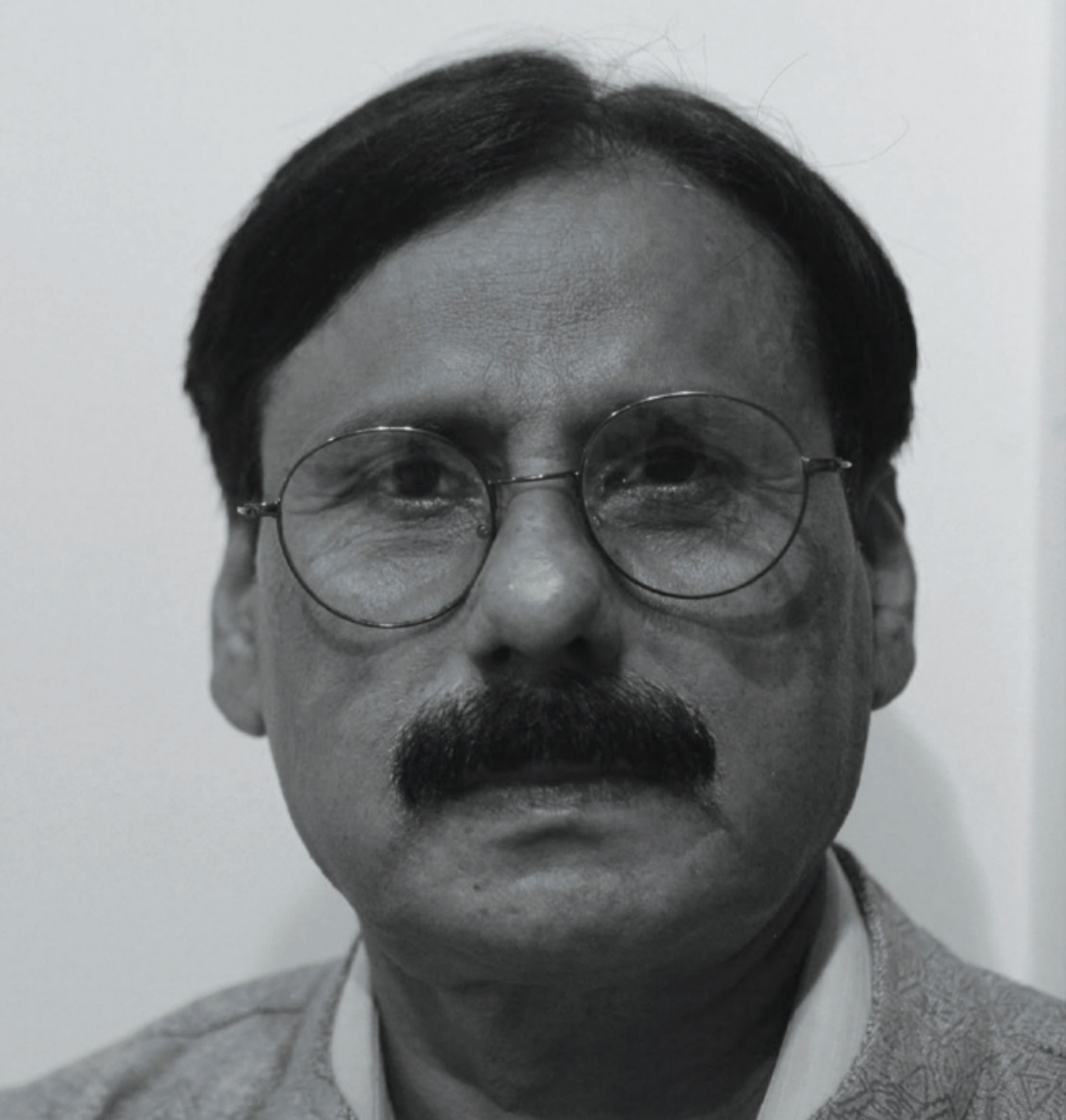
By: Khalid Jawed
-
The book “The Paradise of Food” by Khalid Jawed has been translated from the Urdu by Baran Farooqi. It was published originally in Urdu as “Ne’mat Khana”.
-
It tells the story of a middle-class Muslim joint family over a span of fifty years. As India – and Islamic culture – hardens, the narrator, whose life we follow from boyhood to old age, struggles to find a place for himself, at odds in his home and in the world outside.
-
In this profoundly daring work, Jawed builds an atmosphere of gloom and grotesqueness to draw out his themes. And in doing so he penetrates deep into the dark heart of middle-class Muslims today.
-
Read an excerpt from the book below.
My eldest maternal uncle said that the mohalla in which the house was located had been built on a graveyard. This was the reason almost every home had a grave under it. If there was ever a chance that a house had to be dug deep, the labourer’s spade was sure to hit some skeleton or the other. This was nothing unusual for the inhabitants of the mohalla. They had become accustomed to it.
Cemented graves, at whose heads good-for-nothing boys would lounge all day creating a din, could be seen in the streets too. People sat on those graves and gambled at night. Some graves were considered holy and people offered special chadors on them every Thursday. There was scented smoke from incense sticks and frankincense, roasted flower-like rice and batashas and qawwalis. Every household indulged in holy offerings and charity in the name of saints, and those who belonged to the other sect were categorically unwelcome here.
On the other side, after a long line of farming fields, was the mohalla where those belonging to the other sect lived. No one from that side could cross over and dare to offer namaz in one of our mosques, nor could anyone from our side go to their mosques. Several houses in our mohalla had girls who remained unmarried and grew old and shrivelled. It was preferred that these girls stay unmarried if a suitable match was not found among people of their own creed rather than have them married into households from the other sect.
Our family was one such household. Noorjahan Khala, Sarwat Phuphi, Shaheen Baji and God knows who all remained unmarried. Although I don’t know much about these things, their old age must certainly have been miserable for them.
The house was always noisy, except for summer afternoons and that part of the night when it contained muffl ed voices. There was a deluge of female, male, young and old voices echoing in the house. There were no children’s voices. I was the only child there, but at the time that I’m talking about even my voice would not have been a child’s. In any case, I never regarded myself as a child. The kitchen and Anjum Baji’s lap had made me aware of the existence of a malicious and dangerous male within me.
Every Thursday there would be a fateha between the time of Asr and Maghrib and invariably a mutton curry was cooked for it. Most of the time it was Bade Mamu who made the offering, with a towel covering his head. Sometimes Anjum Baji or Noorjahan Khala or Sarwat Phuphi did the cooking on Thursdays. Wives of my maternal uncles, the Mumanis, their daughters and some maids too could be seen doing something or the other in the kitchen. But a few special dishes, which were prepared on Thursdays with great care and respect, were the responsibility of Anjum Baji, Sarwat Phuphi and Noorjahan Khala.
Bade Mamu believed that every Thursday evening, before the Maghrib prayers, the spirits of our ancestors sit on their graves and wait for the food offerings. And the spirits of those who have been forgotten by their loved ones and do not receive any offerings undergo much sorrow and pain. Bade Mamu also said that at some time or the other on Thursdays the spirits of all the dead people of a household make a visit to the house.
I would sit near Bade Mamu at the time of the fateha. The curry kept in the serving bowls wasn’t fully visible due to the smoke from the incense. One could hardly see anything clearly at that time. The two parts of the day were converging and the entire atmosphere was clouded in an unexplainable haze. I felt sorrowful when I heard the Maghrib call to prayer. There was sadness all around and I thought about the dead people sitting on their graves waiting for their food. Who all were there? Were my parents there too?
But amazingly, after a short while, this scene silently slipped into oblivion and the lantern on the wooden beam began to burn brightly. The whole house turned chirpy and the kitchen was flooded with the sound of clinking bangles.
I only liked the food cooked by Anjum Baji’s hands.
Hands?
Hands have personalities of their own. I have come to know this only now – hands acquire the power of manifestation even before a person’s brain does. Every finger has its own tale to tell. No other part of the human body has such a compact set of bones in it.
Hands are separate from the being, at times even strange and unfamiliar to the mind and the brain and the body. This is the reason different hands cook food that differs in taste, aroma as well as appearance. The kitchen was a museum of the movements and pauses of these hands.
I remember that we had once hired a chef. He used to peel garlic with his feet and everyone watched him in awe and amazement. However, when he expressed the desire to cook food with his feet, not one person approved of the idea. Food is a pure and clean entity. It should be treated with due respect, even if it becomes impure the moment it reaches the large intestine and transforms into a heap of shit.
The chef felt insulted, more so for his art. He immediately quit his job, but before leaving he said it was a pity they didn’t know that sometimes people’s hands descend into their feet. This could also be an illness, like when one’s intestines sometimes get dislodged. Therefore, I am compelled to repeat that hands occupy a mysterious world of their own. They can perform any action. They can go anywhere, they can stroke someone’s hair, wipe someone’s tears and land a slap on someone’s cheek. Hands can even commit murders.
Inside the kitchen, the same thing, never mind if it was the same jar of salt or dry coriander, was kept at the same place in a different manner by different hands. Red chilli powder or turmeric, each hand used them in a distinct fashion, be it the opening or the closing of jars, or just putting them away. If one hand were to sweep the brick floor, there might be some litter left behind. But another might make the floor shine like a mirror. Every hand had its own show and spectacle, and every show prided over its actors, and these actors were the hands.
The kitchen was a parallel world and the women fought among themselves to rule over it. They screamed and shouted and even attacked each other with kitchen utensils, and later wept or threatened to fling the hot ashes of the chulha into each other’s hair. The hands on which bangles jingled turned into fists taking aim in the air. They were each other’s friends, they were each other’s enemies.
This little world of the kitchen was the scene of a pitched battle.
The men of the house were unaffected by this battle. They believed that if there were pots and pans, surely they would clash and collide. They were extremely proud of their ancestral zamindari, even if it had been snatched away, their ownership of land, their superior family background and the age-old tradition of the joint family system. They had no knowledge of the mysterious world of the kitchen. They were ignorant of scorched hands, numb knees and clouded eyes.
I was the only witness to the tamasha of the kitchen. I was a witness to the court set up there every day, and I had to stand in its witness box as the accused one day.
One can’t escape one’s destiny. Destiny walks up to you. Your jaw drops open in surprise to see your destiny appear before you, like an apparition that has sprung out of winding paths and blind alleys. Your feet turn to stone.
By the time I was twelve or thirteen, I developed an addiction for Urdu detective novels. Urdu popular fiction was at its height in the 1960s. I became a victim of this trend in literature thanks to Bade Mamu. I lapped up all kinds of romances as well because of my love for detective fiction. I also became fond of films. Though I seldom got to watch a film, we got film magazines regularly at home. Then there was the radio that played film songs most of the time.
Detective novels, cheap romantic fiction and four-anna movies and their songs have played a major role in shaping my personality.

Coming out of the house, if one were to turn left, there were three or four graves which were in a state of disrepair, and beyond them was Anjum Apa’s house. Anjum Apa was a distant relative who was eight or nine years older than me. Her family had less money than ours and her kitchen was pretty small. It did not have an additional room and utensils were few. They mostly used cow-dung cakes to light the chulha. They also had a rusted and unwieldy kerosene stove. There was an abundance of kerosene oil at Anjum apa’s place as her father was the owner of a government-approved ration shop which sold kerosene oil, along with wheat, rice and low-cost dress materials at subsidized rates. Those days were not like our present materialistic times and that small-sized city had many such shops.
Anjum Apa was quite interested in films and detective novels too. She borrowed novels and magazines at two annas from the mohalla library or the local shops. I began to get novels on rent for her from Mehboob Novel House. I’d spend a major part of my afternoon with her in her kitchen as both of us had similar tastes. She often prepared tea for me with the milk from her goat. Tea prepared on a chulha using cow-dung cakes seemed closer to nature, but destiny? Yes, my destiny was creeping towards me slowly. I don’t know if it was the excessive reading of detective novels or something else that caused the development of a sixth sense in me. I had the dreadful revelation of the presence of a dangerous ability in me.
My intestines were the first to give me a signal of this dangerous ability, or shall we call it frightful knowledge? The grease of the intestines which came out of my mouth. Was that grease a blessing or a curse? I can’t decide with certainty, but I have been repaying that blessing or curse with the interest accrued up until now.
I was quite weak at math and could understand neither numbers nor geometrical figures, or their relationships, ratios and entanglements. But this was a different kind of math. A problem whose solution required different kinds of dishes to convert themselves into geometrical shapes. The kitchen was that wretched space where this knowledge or sixth sense would begin to get ridiculous and unexplainable clues about disease and those suffering from the disease would begin to surface.
All this started one day after an incident in Anjum Apa’s kitchen. This mysterious ability of mine came to light because of an unpolished cooking pot without a lid kept on the floor of Anjum Apa’s kitchen.

Excerpted with permission from The Paradise of Food, Khalid Jawed, translated from the Urdu by Baran Farooqi, Juggernaut Books. Read more about the book here and buy it here.
