

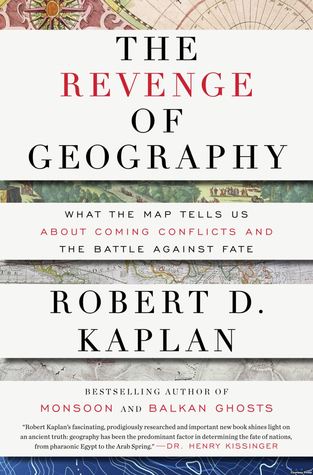
- Book: The Revenge of Geography: What the Map Tells Us About Coming Conflicts and the Battle Against Fate
- Author: Robert D. Kaplan
- Publisher: Random House Trade Paperbacks
Robert D. Kaplan, by virtue of his exploratory journalistic travels, has written a masterpiece titled “The Revenge of Geography”, that is enthralling in its content, evocative in its tone and revelatory in its stance. The book remains an everlasting love of many geopolitical analysts as it attempts to explore the multifaceted nature of global relations with a formulaic vision as the author undertakes a serious globetrotting via his writing. He has enumerated certain fundamental theories and has, at the same time, reflected upon the geographical nature of the polities across the globe by using the aforementioned fundamentals. He has been successful in espousing geography as the main plank of his analysis by focussing on certain aspects of the nation-states that fall within his domain of analysis while he updates the canon of geopolitical studies for the 21st century.
The volume has three parts. Part I, “Visionaries”, examines the geostrategic ideas of numerous writers. Part II, “The Early-Twenty-First-Century Map”, discusses the strategic situation in major world regions, and Part III views “America’s Destiny”.
Part 1 has expressly dealt with the ideas of scholars like Mackinder, Spykman, and Timothy Garter Ash while exploring the debate between the Rimland and the Heartland thesis. Kaplan explores the insights and perspectives of “geographers and geopolitical thinkers of an earlier era”, among whom were Sir Halford Mackinder, who argued that the fate of great empires rests on control of the Eurasian “Heartland”; Nicholas J. Spykman, who contended that the “Rimland”, not the Heartland, held the key to world power. The author has used their theories- like Rimland Thesis, profusely to create certain analogies. As a corollary to that, he has created a dichotomy between the continental and maritime powers, which gets cleared in a chapter titled ‘From Bosnia to Baghdad’ in which he says that “The reunification of Germany according to this logic, rather than lead to the rebirth of Central Europe, would simply lead to a renewed battle for Europe and, by inference, for the heartland of Eurasia….”
The second part is the most expansive one and it discusses “The early twenty-first-century map” in six chapters, on, successively, Europe, Russia, China, India, Iran, and the former Ottoman Empire. This part analyses the geographical positions of these countries and the relief features that have influenced the history, culture, and society of those countries.
When the chapter titled “Russia and the Independent Heartland” is read in the backdrop of the present Russian invasion of Ukraine, it amply gets clear as to why the author found Russia a prisoner to its geography. His prescient writing says “his (Putin) concentration on Ukraine as a part of a larger effort to recreate a sphere of influence in the near abroad is proof of his desire to anchor Russia in Europe, albeit on non democratic terms.” The continental land mass spawned across 11 time zones engenders the Russian idée fixe of creating more buffer areas by means of territorial expansion. By drawing upon the Mackinder’s heartland, he says that Russian influence in the Central Asian countries is trenchant and profusely overbearing and it should, therefore, “discipline its behaviour in Central Asia and likely forswear any attempt to reclaim parts of Mackinder’s Heartland by force.”
However, I’d like to emphasize the chapter titled ‘India’s geographical dilemma’, wherein the author has called India an “ultimate pivot state”. He considers Indian geography as a causal factor for “concentrated invasions from the northwest…..where India is dangerously close to both the Central Asian steppe and the Persian Afghan plateau”. Comparing with China, he says that “whereas Chinese dynasties of old almost completely fall within the current borders of China, the dynasties to which India is heir, as we have seen, do not. Thus, India looks to Afghanistan and its other shadow zones with less serenity than does China to its shadow zones. India is a regional power to the degree that it is entrapped by this geography; it is a potential great power to the degree that it can move beyond it.”
In the chapter “The Geography of Chinese Power”, he points out that while Russia is a land power, “China reaches not only into the strategic Central Asian core of the former Soviet Union, with all of its mineral and hydrocarbon wealth but also to the main shipping lanes of the Pacific . . .” An interesting facet that comes up is that “China is in the early stages of becoming a sea power as well as a land power…” This rings a bell within our minds when we see this in the light of the present situation in the South China Sea, where China’s belligerent manoeuvres have set apace a gory war of attrition within its perceived territory with Taiwan and other neighbouring states. The Galwan clash with India in 2020 marked a major shot in the arm for the Chinese in regards to their territorial ambitions.
In the chapter “Iranian Pivot”, we are reminded of the crucial position of the country in relation to the Caucasus, the Caspian, the Central Asian republics, Afghanistan, Pakistan, Mesopotamia, and the Gulf. The author has approached Iran with a velvet glove. He says that a liberal Iran, though having a tendency to beget fissiparous feelings, “would encourage a more equal fluid balance of power between the Sunnis and Shiites in the Middle East…”. He has also taken a very peculiar approach vis-a-vis Iranian clergy as he says while quoting Olivier Roy that “The Shiite clergy is incontestably more open to the non-Islamic corpus than the Sunni Arab ulamas. The Ayatollahs are great readers (including of Marx and Feuerbach)..” It must not be forgotten that the author was writing all this while the negotiations for JCPOA were underway between the USA and Iran. If read together with Richard Eaton’s ‘India in the Persianate Age’, there’s enough overlapping material that history has created for us (Indians) to make headway in the positive direction by leveraging these convergences that wreathe this region that had had an overbearing influence of the Persian language and practices.
Part III, “America’s Destiny”, asks, “How does America prepare itself for a prolonged and graceful exit from history as a dominant power?” The answer: We must be content with unifying North America and acting as “a balancing power in Eurasia”.
However, there are certain issues with the book as well, which make it a difficult read. Firstly, the language is quite straining, so the book, at times, develops a boring undertone. But it remains subjective in nature. Secondly, the book is vividly technical. If one is not generally aware of the fundamental geographical theories and localized geopolitical events, then it might appear cumbersome and a bit over the top. Thirdly, I don’t exactly agree with his conception of the Indian subcontinent, for that essentially remains fixated with a colonial view of this land being a demarcation between disparate religious groups engaged in competitive one-upmanship. Fourthly, the author has adopted a certain determinism in his analyses stemming from his belief in the timelessness of geography, which rules out any dynamism from the realm of international politics.
This paperback, running for 414 pages, is a bold attempt at looking at the myriad of global affairs with a geographical lens. It’s a prodigious and painstaking attempt by the author to explicate various fundamental forces that determine the functioning and failing of certain countries. This remarkable book, which is already a hot cake among the policy circles, must percolate deep down to our people. Hence, I recommend this book to every individual, who happens to love geography and global affairs, and more so, for the people of J&K who have witnessed this ‘revenge of geography’ first-hand, vividly, in 1947.
