


-
The book “Paachakam” by Sabita Radhakrishna allows readers to enjoy the many tastes of Kerala from the comfort of their own kitchen.
-
This cookbook offers authentic insights into Kerala’s cuisine by drawing attention to the communities that cherish them – Syrian Christians, Namboodris, Cochin Jews, Nairs, and Maplas, to name but a few.
-
In exploring their diverse foods and customs, interviewing community elders, and researching preferred spices and flavors, Sabita Radhakrishna uncovers special commonalities between them that serve to define Kerala cuisine as a whole.
-
Read an excerpt from the book below.
Today, Kerala boasts of a diverse group of communities, the culinary habits of each displaying its own unique character, although almost every dish hints of a mix of coconut and spices. The main spices used in the state are the locally grown cinnamon, cardamom, ginger, green and red peppers, cloves, garlic, cumin seeds, coriander, turmeric etc. Because of the profusion of coconut groves, coconuts and coconut oil are generously used. Seasonal fruits like mango, jackfruit, banana and more are cooked with in several forms. Then there are preparations that bring communities together and are shared amongst them, like the idi appam – steamed rice noodles eaten with coconut milk or chicken curry. Both in Kottayam and Trichur, river fish is eaten and cooked with sour kokum fruit rind or kodampulli. Meenpattichadu or deep-fried sardines are consumed frequently. Jaggery is widely used and cooked with jackfruit and cardamom (chakka varattiyathu). The Kerala roti is podipatthiri, prepared from a boiled mash of rice cooked on a tawa, or a thicker aripatthiri made of parboiled rice or a naipatthiri, which is like a puri made of rice flour with coconut.
The medium of cooking is always pure coconut oil. Fish is a must for non-vegetarians. Curry leaves are used in plenty, and the cuisine is marked by the absence of heavy tempering as compared to other cuisines from the South. The flavours of Kerala are distinct, and when these coconut gratings are fried to a light brown or dark brown as the recipe demands, the richness of the gravy is exceptionally unique.
In the following pages, I have featured recipes from five dominant communities. I had to be selective as the food differs dramatically from region to sects and castes.
The Syrian Christians boast of a rich and varied cuisine. Kal appam and kuzhal appam are typical of the Syrians, as is the errachi olayathi, a special dish made with beef. Roasted duck or wild boar with strong masala is served at Christmas. The Syrian Christian cuisine is most exotic, with every meal a feast replete with fish, mutton, chicken or beef. While I cooked Kerala meals for over a year to understand their spices and familiarize myself with an alien food culture, Syrian Christian food never failed to fascinate me.
Arab traders married Kerala women in the seventh century, and their descendants are the Mappilas of Kerala or Moplahs as they are popularly known. The Arab influence is seen in the biryanis and in the alias, which is a Mappila dish derived from harees, a traditional Arabic dish consisting of wheat, meat (mostly chicken) and salt.
The Thiya community were originally toddy tappers. Appam and stew, common throughout Kerala, are their breakfast delicacies. It could be fish in coconut sauce with mango or mutton cooked in coconut milk, served as accompaniments to the appam.
The Nairs used to be the warrior community of Kerala and their nonvegetarian cooking is extremely popular. They make the vella appam for breakfast or the puttu steamed in hollow bamboo teamed with sweet milk and bananas. Their aviyal is a mix of vegetables like raw bananas, drumsticks, beans and cashews cooked in coconut milk and mixed with sour curds and coconut oil.
The Nambuthiris are the Kerala brahmins in existence from third century BCE. They are strict vegetarians, and eat idli, dosais or puttu for breakfast and have rice with kootu, kalan and olan for the main meals. They avoid eating garlic. I have placed the recipes of the Poduvals and the Nambuthiris together as they meld in flavours and are often very similar.
Kerala is known for its traditional sadyas (feasts), made of a vegetarian meal served with boiled rice and a host of side-dishes. The sadya is, as per custom, served on a banana leaf. Traditional food items include sambar, aviyal, kaalan, theeyal, thoran, injipulli, puliserry, appam, rasam and chakka payasam . Coconut is an essential ingredient in most of the food items and is liberally used. There is a specific place for each item on the plantain leaf. Thus, the waiters can easily identify the requirement of the diner by just looking at the leaf. A heavy meal in the state is always followed by vettilamurukkan – the chewing of betel leaf with lime and areca nut. This aids in digesting the heavy meal and cleanses the palate.
As I came to the end of this collection, so much of which has been collected from friends and family, the one thing that was evident was the diversity of the cuisine in Kerala, which has become increasingly popular and the restaurants serving it always packed.
Note: The following is the recipe of Chakka Varattiyathu (Jackfruit Preserve) from the book.
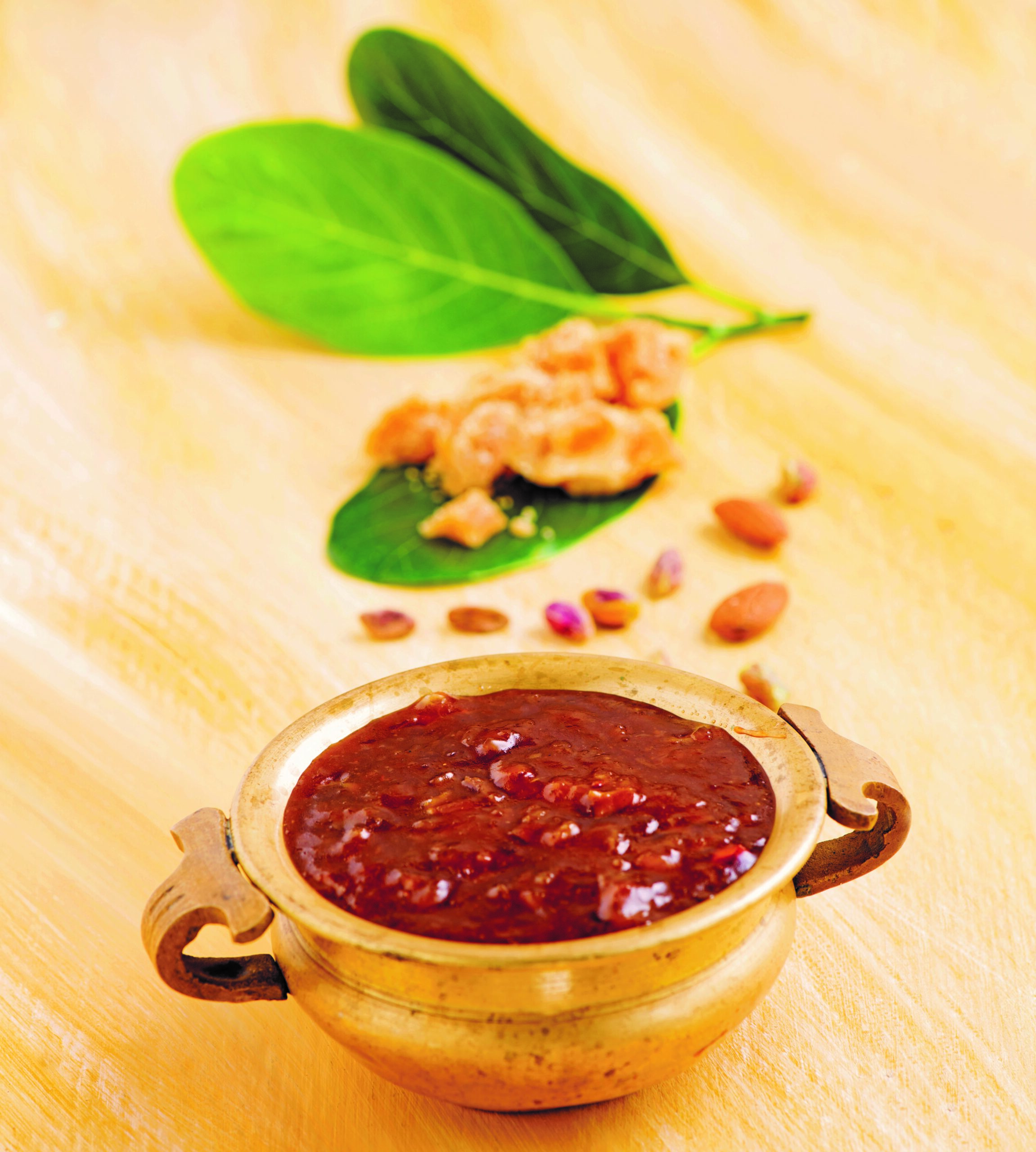
chakka varattiyathu (Jackfruit Preserve)
Made in bulk during season and preserved, this is used for making payasam and kumbilappam.
This recipe makes 2 cups.
Ingredients
2 cups (330 g) (small pieces) ripe seeded jackfruit (kathal), chopped
1½ cups (360 ml) water
1 cup (336 g) jaggery (gur)
4-5 Tbsp (56 to 70 g) ghee
Method 1
1. Pressure cook the jackfruit pieces with 1 cup (240 ml) of water for 15 minutes.
2. In a small saucepan, melt the jaggery with ½ cup (120 ml) of water. Strain the syrup to filter out the impurities.
3. Using a ladle, mash the cooked jackfruit pieces in the cooker. Transfer the mashed fruit into a widemouth, heavy-bottomed vessel or the traditional bell metal uruli. Place the vessel over high heat.
4. Stir in the jaggery syrup. Cook, stirring continuously, until the water evaporates. Taste and add more jaggery, if needed, depending on the sweetness of the jackfruit and quality of the jaggery.
5. Reduce the heat to low. Continue cooking and stirring. Little by little, add the ghee until the mixture turns dark brown in colour and starts pulling away from the sides of the vessel.
Note: A pinch of ground cardamom and ¼ tsp of dry ginger (sonth) may be added (optional).
Method 2
1. In a food processor or blender, purée the jackfruit pieces.
2. In a small saucepan, melt the jaggery with ½ cup (120 ml) of water. Strain the syrup to filter out the impurities.
3. In a wide-mouth, heavy-bottomed vessel or a bell metal uruli, combine the jackfruit and jaggery syrup.
4. Continue with steps 4 and 5 as in the first method.
Note: Using this method will make the mixture splutter, so take care while stirring. If you prefer a very smooth texture, use this method.
