

-
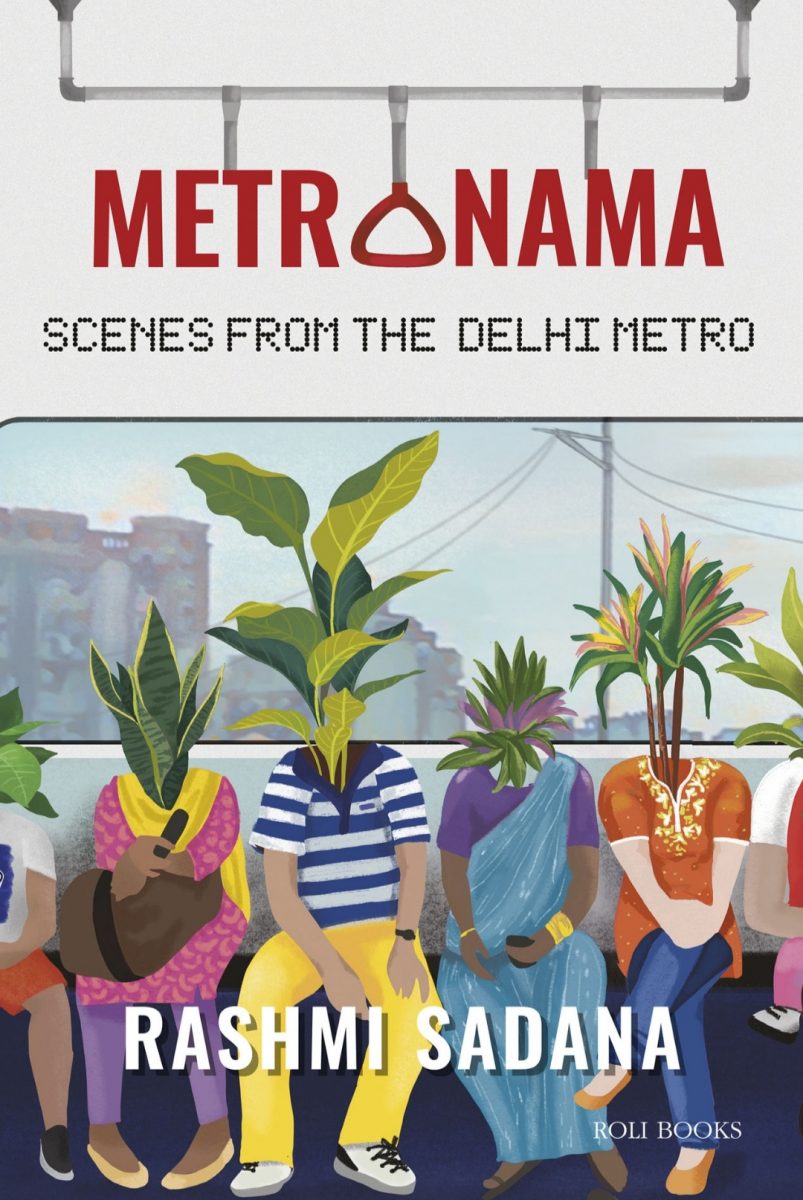
The book “Metronama: Scenes from the Delhi Metro” by Rashmi Sadana is a rich and intimate account of urban transformation told through the story of Delhi’s Metro, a massive infrastructure project that is reshaping the city’s social and urban landscapes.
-
Ethnographic vignettes introduce the feel and form of the Metro and let readers experience the city, scene by scene, stop by stop, as if they, too, have come along for the ride.
-
In the book, through exquisite prose, Rashmi Sadana transports the reader to a city shaped by both its Metro and those who depend on it, revealing a perspective on Delhi unlike any other.
-
Read an excerpt from the book below.
The Metro’s first project manager, E. Sreedharan, who served from 1995–2012, is known affectionately and practically as the “Metro Man” throughout India. He has a hallowed place in the DMRC and in the nation, even many years after his retirement. This image was tarnished somewhat when Sreedharan joined the Bharatiya Janata Party (BJP) in 2021 and ran for a seat in the Kerala state assembly the same year, only to lose to the Congress Party candidate. The eighty-eight-year-old technocrat became a partisan figure, even if only briefly. Nevertheless, Sreedharan is credited not only for getting the Metro built on time and within budget but also for having instilled a disciplined work culture and ethic at the DMRC. As one Delhi-based transport consultant who worked on evaluating Delhi’s Metro for the Japanese told me in 2009, “Without Sreedharan, nothing would happen; if he went, all would stop. He asks the DMRC board of directors to do something, and they jump.”
Sreedharan has been bestowed with numerous national and international awards and became known for his management strategies; he now consults on other metro projects in cities across India and is especially involved in the building of the Cochin metro in his home state of Kerala.
Sreedharan is an engineer, and it was his management style and vision of seeing the Metro as an engineering project that became the system’s hallmark and highest priority. In Sreedharan’s time, the DMRC became such a privileged state entity – as I was repeatedly told by those who worked both within and alongside the organization – that it was able to do what it needed to get the system built. The DMRC did not have to cooperate with other urban agencies because it had the backing of the central government, more funding than any other urban project, and a project manager who was revered and listened to by everyone.
Nonetheless, once the Metro’s first three lines (Red, Yellow, and Blue) were operational, urban planners and commuters began to critique the Metro, especially the user interface between the stations and the rest of the city. What was supposed to happen when you got down from the Metro and stepped across the threshold from the smooth train and gleaming station to the uneven city terrain? The Metro had been imagined and built as a stand-alone project, yet for any urban mass transit system to work, it had to enable commuters to connect to other forms of transport, such as buses, vans, jeeps, cycle rickshaws, auto-rickshaws, or taxis in order to get to their final destinations, to achieve “last mile connectivity.” Hence, issues beyond safety and engineering – planning, design, architecture – came to the fore. These were also issues that required communication across and cooperation among several urban agencies.
In 2013, I met with the chief architect at the DMRC, Papiya Sarkar, to talk about the issue of the interface between the Metro and the city and Delhi’s urbanism more generally. The Metro had already impacted the city; it was part of the urban landscape, yet it was still evolving.
At the time, Sarkar was managing the architecture of sixty stations in the Metro’s third building phase. She also oversaw all of the DMRC architects, each of whom managed dozens of stations at a time, and dealt with the private, contracted architecture firms, both Indian-owned local ones and foreign design and engineering consultancies such as the French Systra. But she was more than a manager. When I met with Sarkar and two members of her team in their office near the Patel Chowk station in Central Delhi, it was clear that they laboured over the meaning and ideas of architecture and urban image on a station-by-station basis. These issues were especially important for the aboveground, elevated stations, which affect the city skyline and interact with other traffic forms. We discussed, for instance, how a Metro line relates to a corresponding flyover and the environmental and aesthetic fallout of such competing structures. She and her team were also aware that they had an ancillary position at the DMRC – although when I met Sarkar two years later, in 2015, she told me that architecture had gained stature in the organization, and I also noticed that her office had been moved to the primary DMRC headquarters, Metro Bhawan, on Barakhamba Road.
“Delhi’s Walled City, the medieval city, was for walking,” Sarkar explained, “Lutyens’ Delhi is for the car.” Her neat contrast was an old one, referring to the dense network of lanes of Old Delhi, with its sometimes shoulder-to-shoulder pedestrian traffic, versus the wide avenues and boulevards of the colonial capital built in 1911, a part of town that continues to be the roaming and residential ground for the city’s political and bureaucratic elites.
“Lutyens’ Delhi,” Sarkar continued, “is exogenous, an imported plan, as opposed to indigenous,” referring to Old Delhi. Two urban forms are also indicative of two contrasting styles of rule and the imperative to create historical continuity (Old Delhi) or disjuncture (New Delhi) in an urban idiom. Sarkar’s historical schema recapitulates colonial-era hierarchies imprinted on the urban landscape, while it also opens up an aspirational narrative for the contemporary city.
“Is the Delhi Metro exogenous or indigenous?” I asked tentatively. A pause followed by silence as her team members glance toward the floor. A moment later, Ankit, one of the younger team members, looked up and said, “It is spontaneous,” and everyone nodded in agreement, and perhaps with some relief.
I found something telling in that moment, perhaps in the very spontaneity of the remark itself. “Spontaneous” suggests that something happens quickly or all of a sudden, which was of course not the case with the Delhi Metro; it had been considered since 1969, even if construction didn’t begin until the late 1990s. It is hard to think of any major infrastructure, let alone megaproject, that could be spontaneous; it goes against the kind of planning that is required by an infrastructural project, including the various forms of excavation, removal, and retrieval necessary before the building can even begin. On reflection, I took Ankit’s word to suggest that the Metro was somehow organic, a need emerging from local realities. Those realities included the city’s traffic congestion and pollution but also the way the city had changed after the liberalization of the economy. There were more places to go to and less time to get to them.
Metro technology and expertise may be global, but the need or desire for a Metro was also a reflection of the city’s own globalising, he seemed to be saying. The city had come to a point where it demanded a state-of-the art, globally recognized form of mass transit, one to take its people to the kind of office and other jobs created by economic liberalization. To extend Ankit’s remark, global technology and expertise became incorporated into the urban landscape and reproduced many times over as metro systems are now being built and are already running in numerous other Indian cities. That spread might also be cast as “spontaneous,” which suggests something that is inevitable, a response to local needs and not external pressures. It may have precedents from elsewhere, but it has evolved locally; it is not imposed.
