

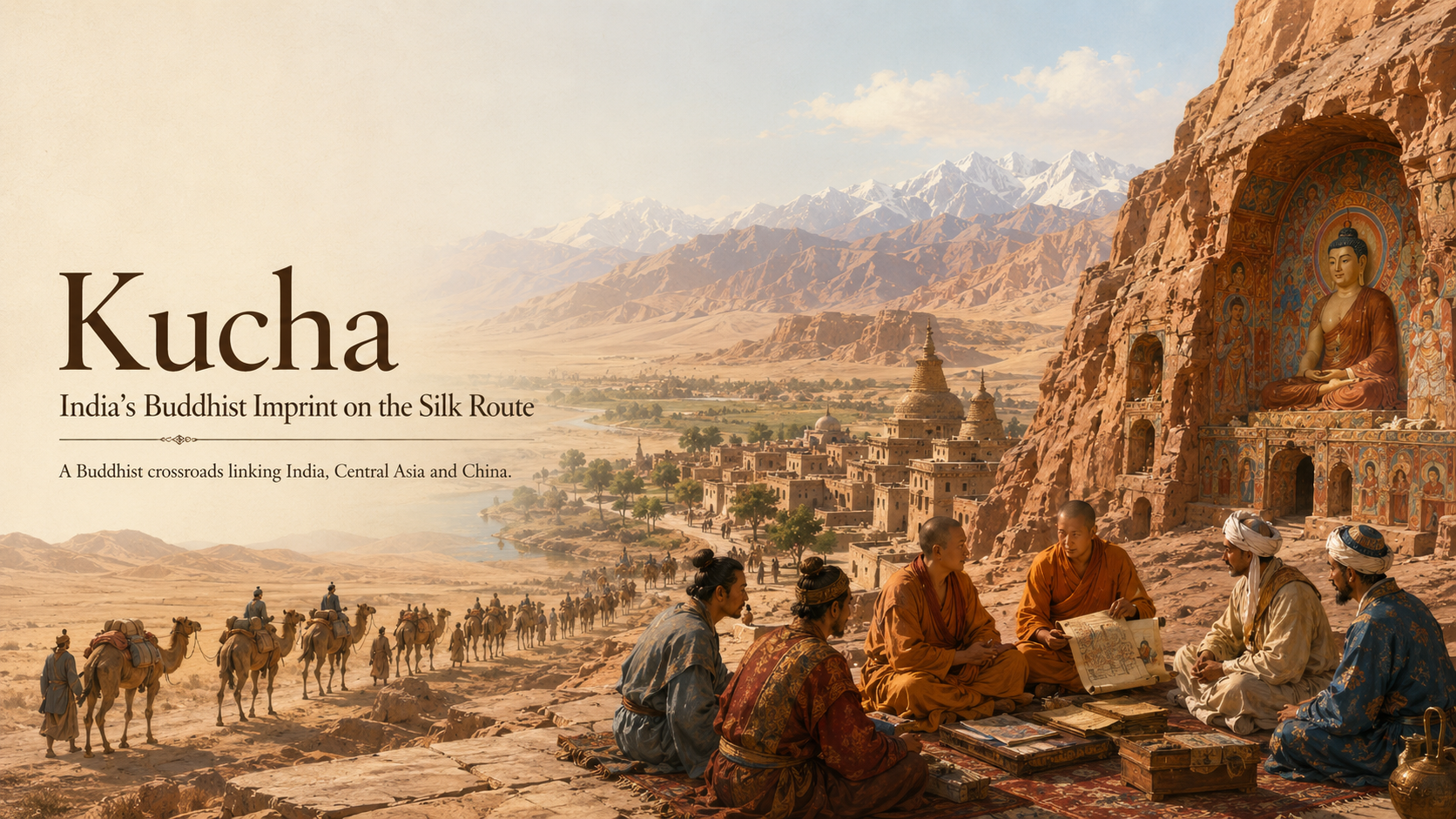
Kucha deserves a far more serious place in how India reads Central Asian history than it usually gets. It was never just an oasis town on the Silk Route. It was one of the great Buddhist centres of the Tarim Basin, and it had a real hand in carrying Indian religious and intellectual traditions eastward towards China.
Set near the northern rim of the Taklamakan Desert, Kucha sat on the road that linked India, Central Asia and China. In the old caravan world, geography decided a great deal. A settlement planted on a hard but busy route became something more than a marketplace — it turned into a meeting ground for traders, monks, artists, translators and travellers. Kucha was exactly that kind of place.
Its link with India came mainly through Buddhism. The faith that began in India travelled through Kashmir, Gandhara and the other north-western regions before it reached the oasis kingdoms of Central Asia. Kucha didn’t simply receive that tradition — it worked on it, and helped push it further east. That is what made the kingdom such a vital link in the chain along which Buddhist Asia slowly took shape.
Few things make this clearer than the Kizil Caves near Kucha. Their murals carry a mix of influences, but the heart of them stays Buddhist, and the stories, symbols and ideas behind them came out of the Indian Buddhist world. You can see in them how Indian religious imagination was picked up in Central Asia and given shape by local hands.
Kucha was a place of learning, too. Its monasteries weren’t only religious institutions; they were where texts were studied, translated and explained. In a world with no printing and no quick way to send word, such places held knowledge in place and let it travel across enormous distances.
The figure most closely bound to Kucha is Kumarajiva. Born there, with family roots traditionally traced back to Kashmir, he became one of the greatest translators of Buddhist texts into Chinese, handing Chinese Buddhism some of its most influential scriptures and readings. Through his work, Indian ideas didn’t just reach China — they settled into Chinese intellectual life and stayed.
Kumarajiva’s story is, on its own, the reason Kucha can’t be brushed aside as a minor stop on a trade route. Here the Indian, Central Asian and Chinese worlds met and mingled. The kingdom took from India, reworked what it took, and passed it along. That made it a transmitter, not just a recipient.
Xuanzang’s travels in the seventh century underline how much this wider region mattered. His road to India ran straight through the Buddhist centres of Central Asia, and while India was, for pilgrims like him, the original wellspring of Buddhist knowledge, the journey to that source leaned on places like Kucha, where Buddhism had already put down deep roots.
This is the part of the story India tends to skip over. The arrival of Buddhism in China is well known; the road it travelled to get there is far less understood. Between India and China stood a whole chain of societies that carried, guarded and interpreted Indian thought — and Kucha was among the most important of them.
India’s influence in Kucha was never that of a state. It was the influence of a civilisation. No army was needed for Indian ideas to take hold there — monks, manuscripts, teachers, traders and artists did the work. That is what gave Indian culture its reach across Asia: it moved through respect, not compulsion.
The history isn’t only of the past, either. India’s conversation about Central Asia today usually circles around connectivity, energy, trade and security, and those concerns are real enough. But the older foundation of the relationship was cultural and intellectual, and Kucha is a reminder that India’s engagement with the region is no recent strategic discovery. It carries a long memory behind it.
That memory is worth holding with some balance. Kucha was not India — it had its own people, its own languages, its own political life — and yet it was deeply marked by Indian Buddhist traditions, and its art, learning and religious institutions belonged to a larger Asian Buddhist network with India at its source.
Kucha stands, then, as a real chapter in India’s civilisational reach: a place where ideas born in India crossed deserts, entered foreign societies and became part of their spiritual life. In that sense it was not only a bridge between India and China, but one of the workshops where Buddhist Asia itself was made.
