

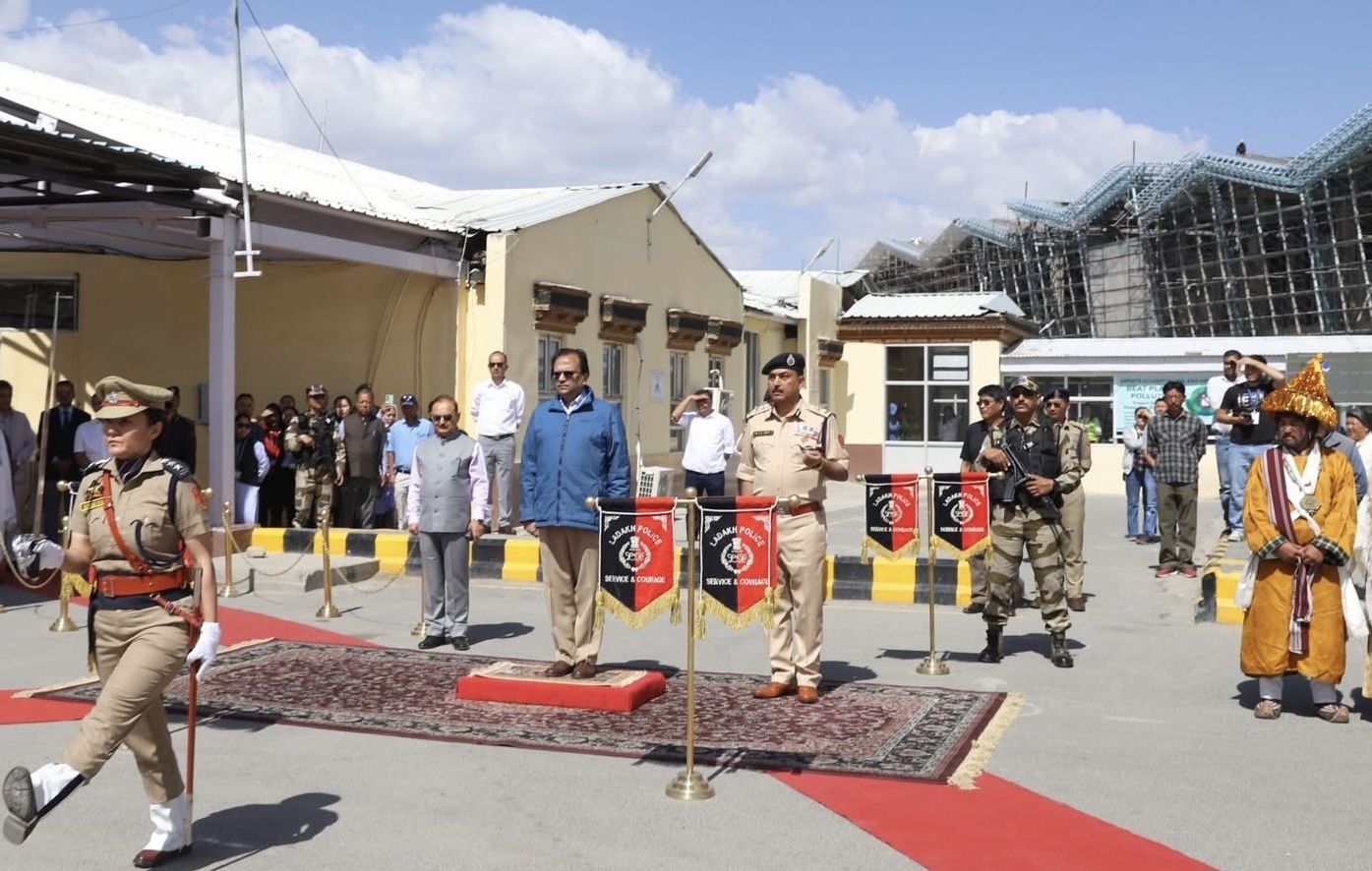
Leh: In yet another indication of Narendra Modi government’s enhanced and personal attention towards the public affairs of the Union Territory of Ladakh, the Home Secretary, Govind Mohan, accompanied by a number of senior officials, arrived in Leh today on a two-day visit.
Mohan’s is one of the several high-profile visits to Ladakh in the recent weeks including that of Finance Minister Nirmala Sitharaman and Law and Justice Minister Arjun Ram Meghwal. Besides the ministerial visits, several high-ranking officers from the central government ministries, corporations and boards are holding regular interactions in the region to deepen a personal connect with the people and give impetus to the developmental process.
Bridging the aerial distance and overcoming challenges of geographical remoteness, these frequent tours of high-profile ministers and officers are translating Prime Minister Modi’s and Home Minister Amit Shah’s vision of embracing the marginalised regions and communities by taking regular firsthand appraisal of their issues and being with them in the region.
Earlier this month Finance Minister Nirmala Sitharaman was in Ladakh on a four-day visit.
During her visit, she interacted with LAHDC leh and Administration of UT Ladakh and will inaugurated various developmental projects. She also chaired a Credit Outreach Program with UTLBC Ladakh emphasizing the vital role of credit in promoting financial inclusion and economic development in the region. The Finance Minister had also visited remote areas such as Nyoma, Hanle, Rezangla and other places in the Changthang region and took stock of the developmental works in the region.
The Finance Minister Nirmala Sitharaman also laid the foundation stone for a Mini Planetarium and Astro Globe at the Hanle Dark Sky Reserve in the Changthang region of the Union Territory. The initiative, sanctioned under the Special Development Package (SDP), comes at an estimated cost of ₹276.65 lakh and aims to promote scientific education, astro-tourism, stargazing, night sky programs, and generate local employment.
The Finance Minister’s visit was quickly followed by the arrival of Law and Justice Minister Arjun Ram Meghwal who stayed in the region for four days and also attended the international yoga festival.
Meanwhile, upon his arrival at Leh Airport this morning, the Home Secretary was accorded a Guard of Honour as per protocol. He was accompanied by Joint Secretary Ministry of Home Affairs Prashant Lokhande. They were warmly received by Chief Secretary Pawan Kotwal, Principal Secretary Sanjeev Khirwar, DGP Ladakh Dr SD Singh Jamwal, Commissioner Secretary Dr. Laltinkhuma Franklin, Administrative Secretary Vikram Singh Malik, Deputy Commissioner Leh Romil Singh Donk and SSP Leh Shruti Arora.
Later in the afternoon, the Home Secretary held a detailed review meeting with Chief Secretary, DGP and all administrative secretaries.
It may be mentioned here that last month the local political groups of Ladakh arrived at an agreement with the Ministry of Home Affairs on a range of local empowerment and constitutional safeguards issues after years of negotiations. The new policies on domicile, recruitments and a range of other issues have been widely welcomed across the region.
ALSO READ
Ladakh Admn notifies areas adjoining Actual Line of Control for Reservation Purposes
Following the May 28 agreement steered by Ladakh groups and MHA panel headed by Minister of State for Home Mr Nityanand Rai, the President of India promulgated, on June 3, the Union Territory of Ladakh Reservation (Amendment) Regulation, 2025, to reserve 85 percent jobs in the region.
The Ministry of Home Affairs has amended the Jammu and Kashmir Reservation Act, 2004 in its application to the Union Territory of Ladakh.
Under the new provisions, the total percentage of reservations in Ladakh will now be capped at 85%, excluding quotas for Economically Weaker Sections (EWS).
As per understanding reached between Union Government and Leh Apex Body & Kargil Democratic Alliance, 80 % percent posts would be reserved for Scheduled Tribes, four percent for residents living near ALC/LoC and one percent for scheduled castes.
The Regulation states that section 5 of Jammu & Kashmir Reservation Act shall not apply to Economically Weaker Sections and filling up of vacancies for such sections shall be in such manner as may be prescribed.”
Section 5 in J&K Reservation Act deals with filling vacancies in reserved categories during recruitment.
According to the provision applicable to J&K, if a sufficient number of candidates is not available from any reserved category during a recruitment process, the posts shall remain vacant and shall be carried forward to the next recruitment process.
It provides that the reserved vacancies remaining unfilled for a period exceeding three years shall be treated as de-reserved.
The President of India has also promulgated “The Ladakh Civil Services Decentralisation and Recruitment Regulations- 2025” to define domicile eligible for jobs in the UT.
The Regulations state that it shall apply to all the gazetted and non-gazetted posts borne on the establishment of any department or service of the administration or a company under the control of administration.
As per notification issued by MHA, these Regulations shall be applicable for the purposes of appointment to any post under the Union territory or under a local or other authority (other than cantonment Board) within the Union territory.
The individuals who have resided in the region for at least 15 years or have studied there for a minimum of seven years and appeared for their Class 10 or 12 exams will qualify as domiciles, the Regulations state.
Besides, children of central government officers, officials of public sector undertakings, autonomous body of central Government, public sector banks, officials of central universities and recognized research institution of central government who have served the Union territory of Ladakh for a total period of ten years ,will also be eligible for jobs.
The Regulations also state that the spouse of a domicile of Ladakh shall also be deemed a domicile.
The Ministry of Home Affairs (MHA) also notified “The Ladakh Civil Services Decentralization and Recruitment-Grant of Domicile Certificate (Procedure) Rules, 2025”, defining five categories eligible for domicile status in the Union Territory.
Under the new rules, individuals holding a Ladakh Resident Certificate (LRC) or those eligible for it will qualify as domiciles, along with their children.
Children of Ladakh residents who live outside the region due to employment or business reasons will also be eligible.
According to the Rules, those who have lived in Ladakh for at least 15 years since October 31, 2019, will be granted domicile certificates. Their children would also be extended domicile benefits.
Those who have studied in Ladakh for seven years and appeared for their Class 10 or 12 exams from October 31, 2019, onwards will also qualify.
Besides, children of central government officials who have served in Ladakh for ten years since its formation as a Union Territory on October 31, 2019, will be eligible to apply for jobs in the region.
