

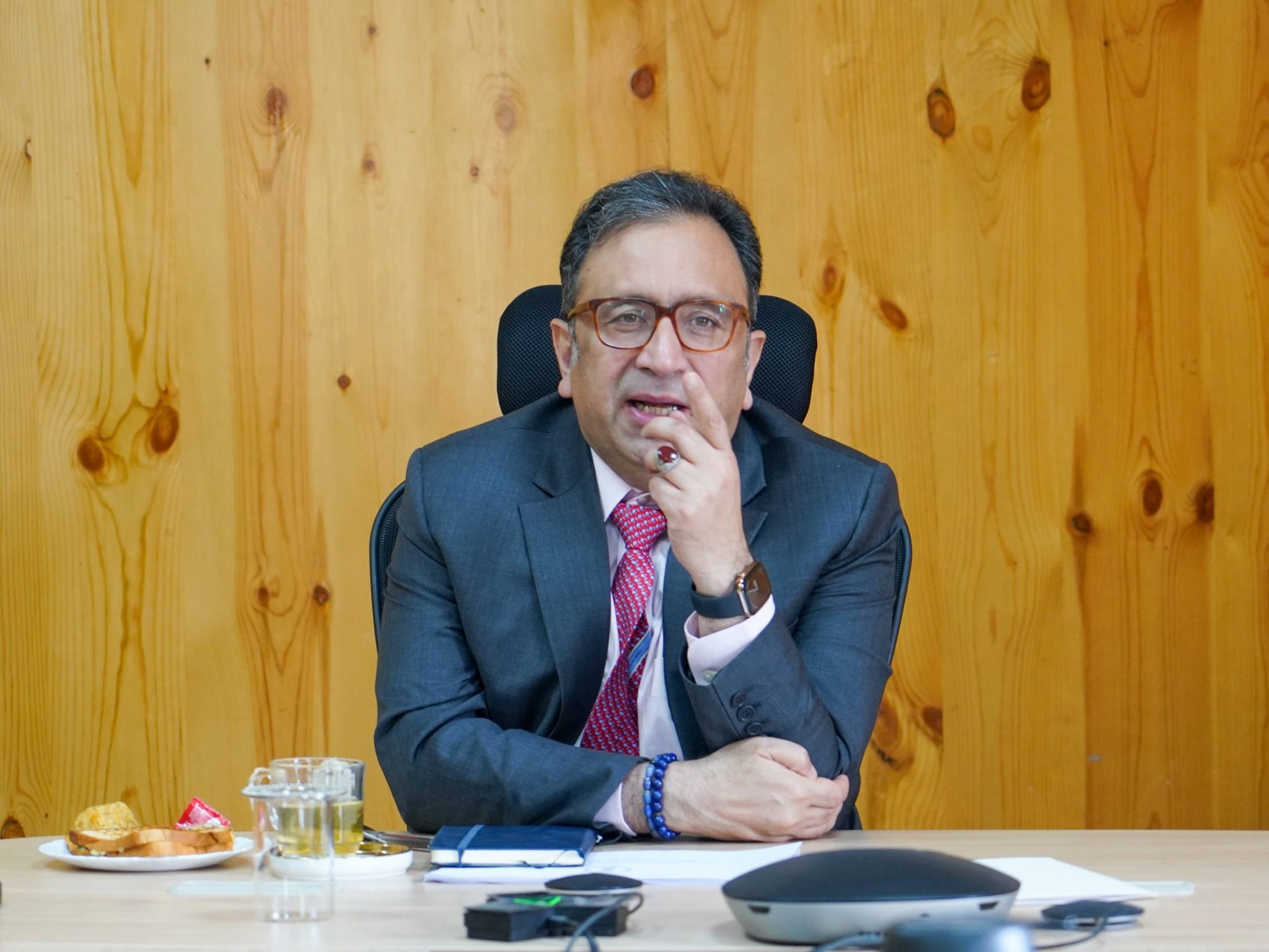
Leh, June 1: Responding to concerns raised by the Leh Apex Body (LAB) over the draft minutes of the May 22 Sub-Committee meeting with the Ministry of Home Affairs (MHA), Ladakh Chief Secretary Ashish Kundra on Monday said the document shared with stakeholders was only a summary of the discussions and not a verbatim record, adding that any constitutional framework emerging from the ongoing dialogue process would ultimately have to be placed before Parliament.
His remarks came after members of the Leh Apex Body stated during a press conference that certain points reflected in the draft minutes were never discussed during the meeting, while some issues that were discussed were missing from the document.
Addressing the issue, Kundra said there was a clear difference between “minutes” and a “record of discussions”.
“Minutes are meant to capture the essence and conclusions of a meeting, while a record of discussions contains every statement made by every participant. The draft that was shared was prepared in good faith so that all stakeholders could understand what emerged from the discussion,” he said.
Kundra pointed out that several earlier meetings of the High-Powered Committee and the Sub-Committee had taken place without formal circulation of minutes. He said this was the first time a draft document had been shared among participants to maintain transparency and facilitate further dialogue.
“If anyone feels that certain aspects have been omitted or there are inaccuracies, the administration remains open to discussion. We are available, and any concerns can be conveyed to the Government of India through proper channels,” he said.
The Chief Secretary described the May 22 meeting in New Delhi as a “breakthrough moment” in the political dialogue between Ladakh’s representatives and the Centre. The meeting was attended by representatives of the Leh Apex Body (LAB), Kargil Democratic Alliance (KDA), Member of Parliament Haji Hanifa Jan, former MP Thupstan Chhewang, officials of the Ministry of Home Affairs and senior Ladakh administration officials.
According to Kundra, the discussions marked a significant shift in the dialogue process, which for years had remained stalled between competing demands and differing viewpoints.
“For a long time, different groups were raising their concerns separately. The Centre was looking for a constitutional solution that could address the aspirations of the people while remaining within the framework of the Constitution. After extensive discussions, a very constructive conversation took place,” he said.
Kundra revealed that one of the major outcomes of the meeting was the discussion around a customised constitutional arrangement for Ladakh under provisions similar to Article 371, which currently provides special constitutional safeguards to states such as Nagaland, Sikkim and Mizoram.
He said the core demands raised by Ladakh’s leadership have consistently centred around protection of land, preservation of culture, and safeguarding employment opportunities for local youth.
“While there have been demands for Statehood and Sixth Schedule status, the central concern has always been protection of land, culture and jobs. The discussions explored whether a customised constitutional solution could be created for Ladakh,” he said.
According to Kundra, deliberations included the possibility of creating a political structure with legislative and executive powers at the Union Territory level, along with stronger district-level democratic institutions across Ladakh. Similar proposals were also discussed during the MHA-Ladakh dialogue process held on May 22.
He said all stakeholders broadly agreed in principle to continue working on such a framework and develop its finer details through further consultations.
“There was broad agreement that the framework should now be detailed further. The Government of India has asked the representatives from Ladakh to submit a document outlining their vision. Simultaneously, discussions will also take place with the Law Ministry, and further drafts will be prepared,” he said.
Kundra stressed that discussions were still at a preliminary stage and that the finer components of the proposed arrangement would require extensive legal and constitutional examination.
“The next phase is to determine what components this framework will contain, how it will function and how it can be implemented. Ultimately, if constitutional changes are required, the matter will have to go before Parliament,” he said.
The Chief Secretary said the current atmosphere of dialogue reflected a new level of trust between Ladakh’s leadership and the Centre.
“In the last few months, I have realised that this is fundamentally an issue of trust. If discussions move forward in an atmosphere of confidence and mutual understanding, many doors can open,” he said.
He added that the Centre had candidly explained during the talks that immediate Statehood was difficult because of Ladakh’s present financial structure and revenue limitations. However, he noted that the Government of India had shown unprecedented openness by discussing governance models tailored specifically for Ladakh.
“The Government of India has initiated discussions on a customised constitutional model that does not exist elsewhere in the country. That itself reflects a willingness to address the aspirations of the people of Ladakh,” Kundra said.
Calling upon all stakeholders to maintain the positive momentum generated by the recent talks, the Chief Secretary expressed optimism that the ongoing engagement between Ladakh’s representatives and the Centre could eventually lead to a durable political and constitutional solution.
“The discussions have reached a very important stage. If all sides continue to engage positively and constructively, meaningful outcomes can emerge in the coming months,” he said.
