

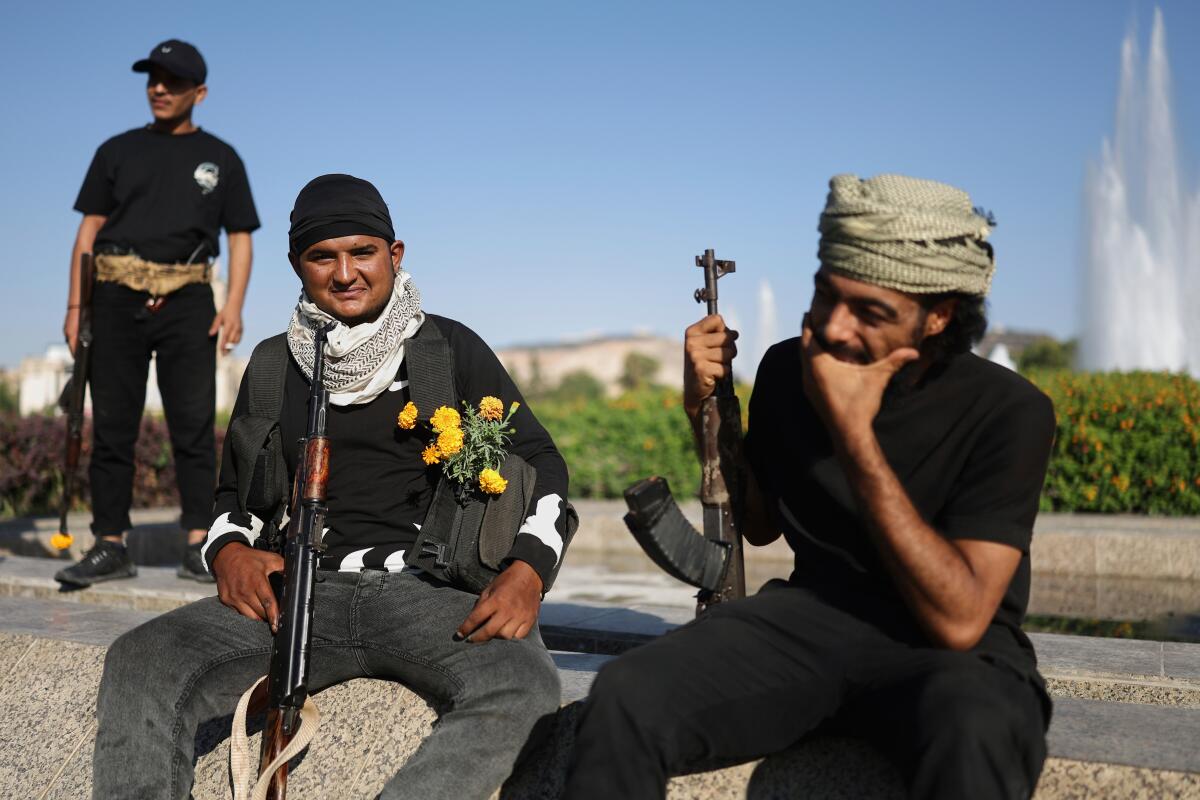
Damascus: Syria’s interim President Ahmad al-Sharaa urged Sunni Muslim Bedouin tribes Saturday to “fully commit” to a ceasefire aimed at ending clashes with Druze-linked militias that left hundreds dead and threatened to unravel the country’s postwar transition.
Despite the call, clashes continued in the southern province of Sweida.
Government forces that were initially sent to restore order but effectively sided with the Bedouins against the Druze were redeployed to halt renewed fighting that erupted Thursday in the southern province of Sweida.
The violence also drew airstrikes against Syrian forces by neighbouring Israel before a truce was reached.
In his second televised address since the fighting started, al-Sharaa blamed “armed groups from Sweida” for reigniting the conflict by “launching retaliatory attacks against the Bedouins and their families.” He also said Israeli intervention “pushed the country into a dangerous phase.”
Israel had launched dozens of airstrikes on convoys of government fighters and even struck the Syrian Defence Ministry headquarters in central Damascus, saying it was in support of the Druze, who form a substantial community in Israel and are seen as a loyal minority, often serving in the Israeli military.
Reports had surfaced of Syrian government-affiliated fighters executing Druze civilians and looting and burning homes over the four-day violence.
Ceasefire agreed to early Saturday
The US envoy to Syria, Tom Barrack, announced that Israel and Syria had agreed to a ceasefire early Saturday. Al-Sharaa made no direct reference to the agreement in his speech, but said “American and Arab mediations stepped in” to restore calm.
Addressing the Bedouins, al-Sharaa said they “cannot replace the role of the state in handling the country’s affairs and restoring security.” He also said: “We thank the Bedouins for their heroic stances but demand they fully commit to the ceasefire and comply with the state’s orders.”
Meanwhile, a prominent Druze leader, Sheikh Hikmat Al-Hijri, who opposes the current government and has distanced himself from the two ceasefires announced on Tuesday and Wednesday, said that an agreement brokered under the sponsorship of guarantor states contained several measures aimed at de-escalating tensions in Sweida.
They include the deployment of checkpoints outside the province’s administrative borders to contain clashes and prevent infiltration, a 48-hour ban on entry by any party into border villages, and safe, guaranteed passage for remaining members of the Bedouin tribes still inside the province.
Sharaa reiterated that Sweida “remains an integral part of the Syrian state, and the Druze constitute a fundamental pillar of the Syrian national fabric,” vowing to protect all minorities in Syria.
He also thanked the United States for its “significant role in affirming its support for Syria during these difficult times,” as well as Arab countries and Turkey, which mediated Wednesday’s truce.
More than half of the roughly 1 million Druze worldwide live in Syria. Most of the other Druze live in Lebanon and Israel, including in the Golan Heights, which Israel captured from Syria in the 1967 Mideast War and annexed in 1981.
Entire communities have fled the fighting
The UN estimates more than 87,000 people have been displaced in Sweida province since July 12 due to heavy shelling, sniper fire and abductions.
Entire communities have fled on foot, with many now crammed into overcrowded schools, churches and public buildings under dire conditions, the UN Office for the Coordination of Humanitarian Affairs said in a report.
Infrastructure damage has cut electricity, water and telecommunications in much of the area, it said. The main hospital in Sweida was operating at just 15 per cent capacity due to staff shortages and a lack of fuel.
The security situation is also endangering humanitarian workers. The White Helmets, also known as the Syrian Civil Defence, reported that one of its emergency team leaders went missing on July 16 while responding to a call for help from a UN team, OCHA said.
Shoring up the ceasefire agreement
Meanwhile, Jordan, Syria, and the US agreed on a set of practical steps to bolster the ceasefire, including the deployment of Syrian security forces and the release of detainees from all sides, Jordan’s Foreign Ministry said on Saturday. The announcement came after a meeting between Barrack, Syria’s Foreign Minister Asaad al-Shibani and his Jordanian counterpart Ayman Safadi.
For his part, Syria’s Minister of Information Hamza Al-Mostafa on Saturday said the first phase of the ceasefire, expected to take 48 hours, involves deploying internal security forces to key areas to prevent clashes. He acknowledged ongoing fighting in Sweida and said every ceasefire “begins fragile.”
Subsequent phases will open humanitarian crossings and gradually restore state institutions and security to ensure a return to normalcy, al-Mostafa said in a press conference in Damascus.
Al-Mostafa acknowledged that some security personnel committed violations after deploying in Sweida. He rejected reports that the violence in Sweida was “premeditated operation” by the Syrian government.
“The armed groups present in Sweida insisted on a provocative approach, rejecting any solutions and relying on a closed-off model that disregards Syria’s unity,” Al-Mostafa said.
He accused Al-Hijri and his supporters of being “armed with Israeli support” and blamed them for “steering the situation toward its current state,” despite previous government attempts to reach an agreement.
Al-Mostafa also denied that Syria and Israel are in direct peace talks. “All discussions that are happening with Israel are fixated on one issue related to the urgent Israeli withdrawal from the areas that it occupied and advanced in after December 8 and its commitment to the 1974 agreement of disengagement,” he said.
Signs of unrest in Damascus
But even as officials called for calm, signs of unrest spread to the capital. On Friday, men armed with sticks stormed a peaceful protest outside Syria’s parliament in Damascus, beating demonstrators and tearing up a banner that read, “Syrian blood should not be shed by Syrians,” according to one of the organisers.
The protest was held in response to the deadly clashes in Sweida, which journalist and filmmaker Zein Khuzam described as a grim echo of the 2011 Syrian civil war.
“We felt like we needed to do something,” Khuzam told The Associated Press. “We started receiving help messages from our friends in Sweida, that they are trapped there.”
The demonstration began Thursday as a spontaneous act by Khuzam and two others, who stood in front of parliament holding signs, including slogans rejecting Israeli interference. Photos of the protest circulated online, drawing a larger crowd the next day.
Khuzam said the group noticed a man acting suspiciously on Friday. After making a phone call, he left, and shortly afterward, the attackers arrived in cars, some with women inside who cheered them on, she said.
She added that guards outside the parliament stood by as someone fired shotgun rounds to disperse the crowd.
“People are still carrying the traumas of Assad’s actions during such peaceful protests,” she said. “In that moment, it felt like history was repeating itself. It is very, very sad.”
