

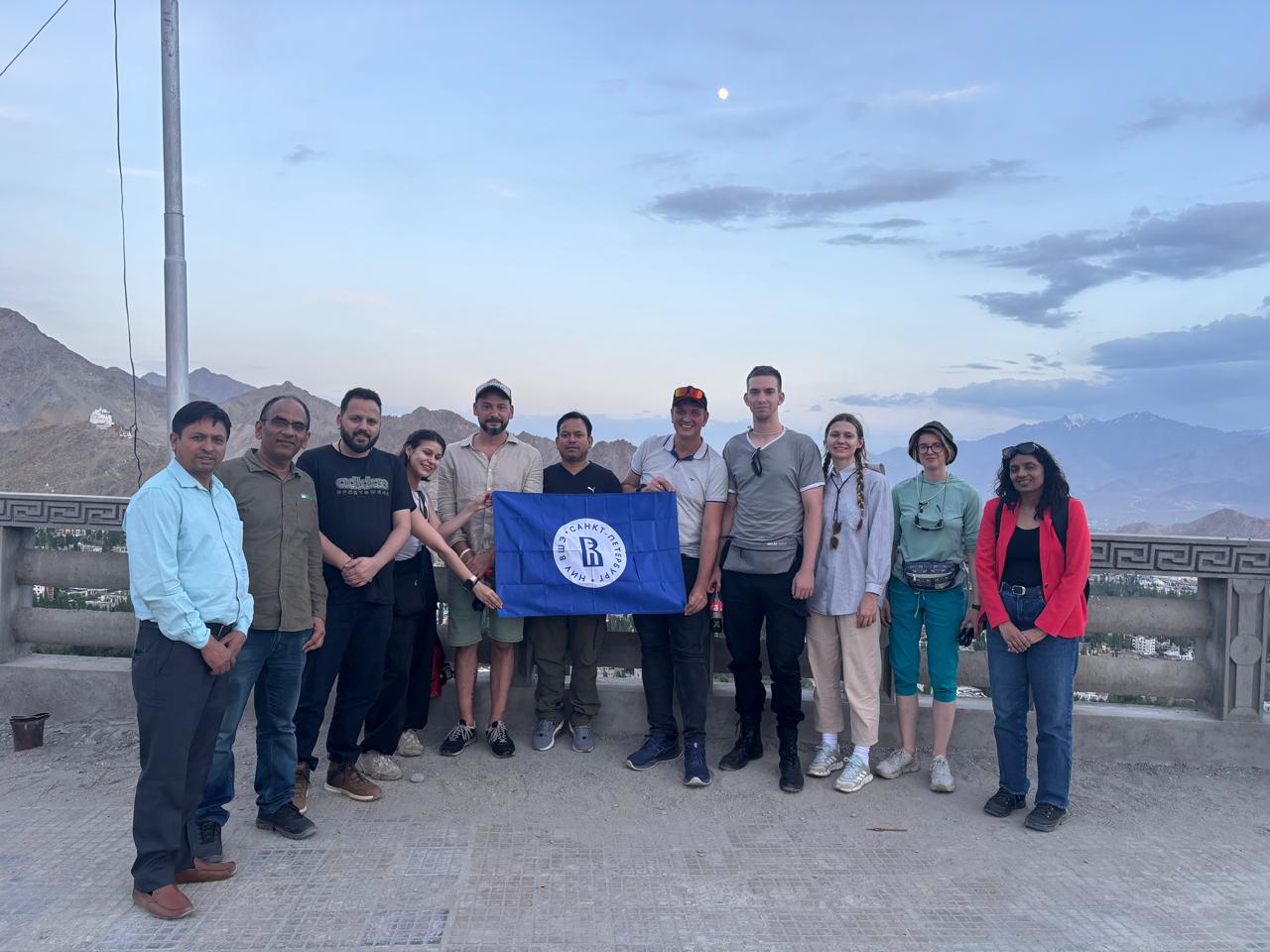
Leh: In a landmark initiative to tackle the mounting climate crisis in the Himalayas, the University of Jammu’s Bhaderwah Campus, in collaboration with University of Delhi and international partners, has launched the 3rd International Summer School and Expedition focused on “Confronting the Climate Challenge in the Indian Himalayas: Pathways to Resilience.” The program, held from July 5–15, 2025, is being hosted on the ground in Ladakh, one of the most ecologically vulnerable regions in India.
The academic expedition is jointly organised by the Department of Environmental Studies, PGDAV (M) College, University of Delhi, the Centre for Interdisciplinary Studies on Mountain and Hill Environment (CISMHE), and the Department of Earth Sciences, Institute of Mountain Environment, Bhaderwah Campus, University of Jammu.
This year’s summer school brings together renowned scholars, climate scientists, and policy experts from India and Russia, including a high-level delegation from HSE University, Saint Petersburg, who are engaging directly with local Ladakhi communities. Their objective is to document on-ground climate vulnerabilities and design community-driven climate resilience strategies.
Key concerns under study include glacial melt, changing precipitation patterns, water scarcity, and livelihood threats, which are increasingly affecting daily life in Ladakh. The team is also examining the consequences of unregulated development and the urgent need to balance ecological preservation with local economic needs.
Prof. Rahul Gupta, Rector of Bhaderwah Campus, lauded the initiative and stressed that field-based collaborative research is the need of the hour. “Ladakh’s fragile ecosystem makes it a critical zone for climate research. These kinds of academic outreach programs can help shape better governance and adaptive policies,” he noted.
Prof. Darvinder Kumar, Principal of PGDAV College, has ensured that grassroots data collection and scientific methodology remain central to the expedition’s research framework, enhancing both academic depth and practical relevance.
Prof. Vandana Mishra, Director of CISMHE, highlighted the Indo-Russian collaboration’s impact in three core areas: enabling on-ground research on climate resilience and sustainable agriculture; generating field-based data for biodiversity and water management; and strengthening international academic cooperation through joint studies, exchange programs, and funding opportunities.
Prof. Alexander, Dean of the School of Social Sciences, HSE University (Russia), emphasized the importance of merging traditional Ladakhi knowledge systems with modern scientific methods to design effective policy interventions.
Dr. Pardeep Singh, the Convener of the Summer School, called for integration of indigenous knowledge and cross-sector dialogue among academics, policymakers, and civil society to ensure climate resilience in Himalayan communities.
Dr. Chhering Tandup, Organizing Secretary from Ladakh, said it was crucial that such efforts happen on-site, adding, “When climate dialogue happens in the community it impacts, the results are more grounded and meaningful.”
Dr. Richa Agarwal Malik highlighted that key research during the field expedition includes studying local awareness of climate impacts, current coping mechanisms, and the level of support expected from administration. She stressed the urgent need for economically viable and ecologically sustainable strategies suited to Ladakh’s unique terrain and constraints.
Other eminent contributors to the program include Dr. Chander Pal Singh, Dr. Chhetan Chhoidub, and Dr. Dimitri Omelchenko, each bringing valuable scientific and cultural perspectives to the initiative.
The Summer School represents a critical step forward in developing localised yet globally relevant solutions to the climate crisis, positioning Ladakh not only as a region of concern but also a hub for climate innovation and resilience-building in the Indian Himalayas.
