


Leh: Ladakh is famous in the country and the world for its supernatural beauty and beauty. Ladakh is called the crown of India.
Today we are going to tell you about the Nubra Valley situated in the middle of the mountains of Ladakh. Nubra Valley is surrounded by high hills.
Also read : Tsomoriri Lake: Highest Ramsar site in world
Natural scenery
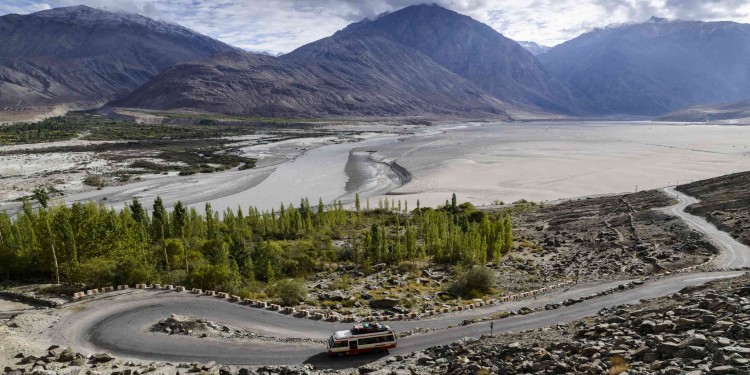
Nubra Valley is adorned with natural scenery. The sand, hills of this valley work to add beauty to the beauty of this valley. The culture here is also quite different. Nubra means “valley of flowers”. This valley is also known as “The Garden of Ladakh”. The valley is adorned with “pink” and “yellow wild roses”.
The Nubra Valley is located in the northernmost part of Ladakh, at an altitude of just over 3,000 meters (about 10,000 feet) above sea level. It lies between the mighty Karakoram and Ladakh mountain ranges, about 150 kilometers (93 miles) north of Leh across the Khardung La mountain pass.
The area is actually made up of two valleys — Nubra and Shyok — created by rivers of the same names. These rivers originate from the Siachen Glacier, on either side of the Karakoram Range. The Nubra River merges into the Shyok River near Diskit (the headquarters of the Nubra Valley).
In addition to Diskit, popular destinations Hunder, Turtuk and Tyakshi are situated alongside the Shyok River, which joins the Indus River in Pakistan. Alongside the Nubra River are Sumur, Tiggur, Panamik and Warshi.
Also read : Why Pangong lake deserves a visit?
What to Do There

The Nubra Valley, at the “cultural crossroads” of Tibet and Central Asia, is a fascinating meeting place of two religions — Buddhism and Islam. The main tourist destinations and attractions can be covered in three days, although there are options for trekking and camping for those who want to stay longer.
To get acquainted with the Nubra Valley’s Buddhist heritage, visit its prominent Buddhist monasteries. The largest one is clustered on a hill above Diskit. If you’re willing to wake up early and arrive by dawn, you’ll be able to catch the monks’ evocative daily morning prayers accompanied by a melody of chanting, horns and cymbals. Walk further up behind the monastery for magnificent views of the Shyok Valley below. For an unforgettable experience, try and attend the monastery’s annual 2-day Diskit Gustor festival in October, where the monks perform masked dances. The unmissable landmark 100 foot-tall statue of Maitreya Buddha, which watches over the valley, is another highlight in Diskit. This more recent addition was inaugurated by the Dalai Lama in 2010.
You’ll find more Buddhist monasteries in the vicinity of Hunder, Sumur, and Panamik. Chamba Gompa at Hunder features an imposing large gold Maitreya Buddha statue, vibrant frescoes, and interesting Buddhist sites dotted around it. Samstanling Monastery, near Sumur, was relatively recently constructed in the 19th century but is beautifully decorated inside with paintings and wall hangings. From Panamik, it’s worth visiting little-known Ensa Monastery perched on the other side of the Nubra River, where an elderly monk lives in solitude. The monastery has a curious footprint in one of its prayer rooms. It’s believed to belong to a monk called Dachompa Nyima Gungpa, whose religious cloth gave him the power to fly. Ancient and remote Yarma Gonbo Monastery is further on, towards Warshi, and can now be reached by tourists.
Also read | Tsomoriri Lake: Highest Ramsar site in world
Panamik is best known for its natural therapeutic hot water sulfur spring, which may relieve aches and pains. Despite the new bathhouse there, some tourists find it underwhelming. A short 10 minute hike to holy Yarab Tso lake, in the mountains near the entrance of the village, is more rewarding.
The atmospheric Tiggur village (also called Tegar or Tiger), between Sumur and Panamik, is developing as a tourism hot spot. It’s home to Zimskhang Gompa, the ruins of a palace that belonged to a local chieftain. There are more fort and palace ruins in nearby Charasa.
In the sand dunes between Diskit and Hunder, a sunset ride on a Bactrian camel is an iconic thing to do. This barren expanse was formed in 1929, by a major flood that washed away a dense forest of sea buckthorn. Wind swept sand up from across the valley and deposited it there. Camel riding is possible at Sumur too, although the dunes are less impressive.
Do allocate a day to visit the Balti Muslim villages beyond Hunder, with their distinctly different landscape and culture. The Balti Heritage Museum in Turtuk provides insight into local history, from the time the village was inhabited by the Brokpa tribe and later taken over by warriors from Central Asia. You may also be able to meet the “king” of Turtuk, Yabgo Mohammad Khan Kacho, a descendant of the Yabgo Dynasty that ruled Baltistan for 2,000 years. He still occupies the former palace, and has converted part of it into a museum to showcase the dynasty’s memorabilia. Old wooden mosques that have withstood the test of time are another draw in Turtuk. While you’re there, dine on authentic Balti cuisine at the Balti Kitchen near Maha Guest House or Balti Farm at Turtuk Holiday Resort.
Although Siachen Glacier is now open for tourism, it is regulated by the Indian Army and requires permits. At 15,000 feet above sea level, only those who are deemed fit enough to deal with the extremities of the glacier will be allowed to go there.
How to Get There
It takes five to six hours to reach Diskit from Leh in Ladakh. The main way of getting there is via Khardung La, which passes over the Ladakh mountain range. It’s often incorrectly claimed to be the highest motorable road in the world, at a height of 5,602 meters (18,380 feet) above sea level. However, the Indian government has stated its real height to be only 5,359 meters (17,582 feet). Regardless, you won’t want to spend any longer than about 15 minutes there due to the altitude, or you’re likely to feel lightheaded.
There’s an alternative, more difficult route into the Nubra Valley to the east of Khardung La. It crosses Wari La from Sakti, and connects to the main road via Agham and Khalsar alongside the Shyok River. You can reach the Nubra Valley from Pangong Lake, via Durbuk and Shyok villages, as well. This route is growing in popularity.
Public transport is intermittent. So, traveling by private vehicle is most convenient. This might not be feasible for budget travelers, as a taxi will typically charge 10,000-15,000 rupees for a two-day round trip to the Nubra Valley from Leh.
Fortunately, buses run from Leh bus stand to Diskit three times a week — departing early in the mornings on Tuesdays, Thursdays and Saturdays. You can expect to pay about 500 rupees for the round trip by bus, which is quite a difference! In addition, a bus runs directly from Leh to Turtuk on Saturday mornings, and from Leh to Panamik on Tuesday mornings.
Taking a shared jeep from Leh to Diskit, Hunder or Sumur is another budget option, at a cost of 400-500 rupees per person one way.
Foreigners should make transport arrangements through a registered travel agent in Leh, as it’s necessary to get a Protected Area Permit (PAP) to visit the Nubra Valley. According to the rules, at least two foreigners must be in a group to apply for a PAP. However, travel agents will add solo travelers to other groups (so, you can share their taxi too). You don’t need to join the group though. Travelers do go alone after getting the permit and are rarely questioned (you can always say your companion is ill or will be coming later).
Note that citizens of Afghanistan, Burma, Bangladesh, Pakistan and China need permission from the Ministry of Home Affairs in Delhi for a PAP, and should apply through the Indian consulate in their country.
Also read Nubra Valley: The gardens of Ladakh
Indian citizens must have an Inner Line Permit (ILP) to visit the Nubra Valley. The requirements are less strict and it’s now possible to apply for the permit online here. It can also be obtained from the Tourist Information Center near Jammu and Kashmir Bank in Leh’s Main Bazaar.
Khardung La is open throughout the year. However, the tourist season in the Nubra Valley extends from May to October, peaking in July and August. Go in late September or early October to avoid the rush. The Nubra Valley is at a lower altitude than Leh, so it doesn’t get as cold.
