

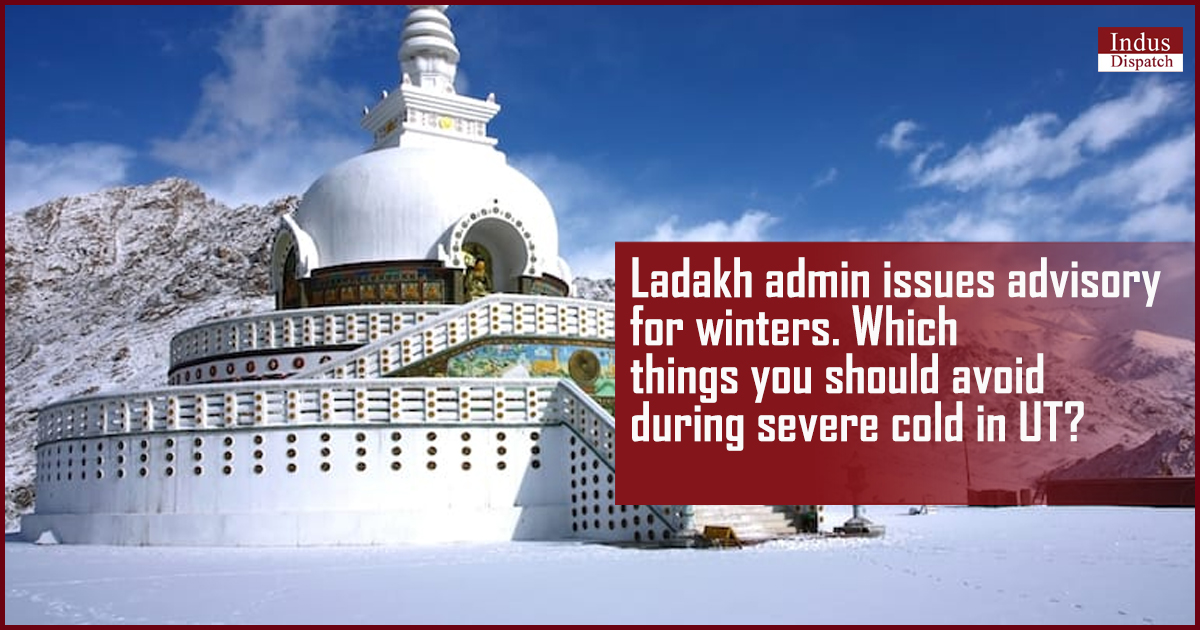
Leh: As the temperature is plunges below normal and several areas of of Ladakh shivering under sub-zero temperature, the Department of Disaster Management, Relief, Rehabilitation and Reconstruction has issued complete advisory.
Here is complete advisory
Before
- Lsiten to the radio, watch TV, read newspapers for local weather forecast to know if a wave is :Oland the corner.
- Stock adequate winter clothing. Multiple layers of clothing are more helpful.
- Keep emergency supplies ready.
- An increased likelihood of various illnesses like flu, running / stuffy nose or nosehleed, which usually set in or get aggravated due to prolonged exposure to cold, Consult the doctor immediately for such symptoms.
During
- Follow weather information closely and act as advised.
- Stay indoors and minimize travel to prevent exposure to cold wind.
- Keep yourself dry, wear multiple layers of loose fitting woolen clothing, cover your head, neck, hands and toes adequately.
- Eat healthy food. fruits and vegetables rick in Vitamin-C to maintain adequate immunity and equilibrium of body temperature.
- Drink hot fluids regularly, as this will maintain body heat to fight cold.
- Store essential supply of goods as per requirement and adequate water as pipes may freeze.
- ‘Take care of elderly peole and children and check neighbours who live alone.
- Do not burn coal indoors for generating heat-closed spaces could be dangerous as it can produce carbon monoxide which is very poisonous and can kill persons in the TOC713.
- Watch out for symptoms of frostbite like numbness, white or pale appearance on fingers, me, ear lobes and the tip of the nose, while exposed to cold wave.
- Someone suffering from Frosbite / Hypothermia-like a decrease in body temperature which can cause shivering, difficulty in speaking, sleepiness, stiff muscles, heavy breathing, weakness and / or loss of consciousness. Hypothermia is a medical emergency that needs immediate medical attention. Consult doctor immediately for symptoms like various illnesses, running / stuffy nose.
In the case of hypothermia:
- Get the person into a warm place and change clothes.
- Warm the person’s body with skin-to-skin contact, dry layers of blankets, clothes, towels or sheets.
- Give warm drinks to help increase body temperature. Do not give alcohol.
- Seek medical attention if the condition worsens.
Don’ts:
- Avoid prolonged exposure to cold
- Don’t drink alcohol that reduces body temperature; and narrows blood vessels, particularly in hands, which can increase the risk of hypothermia.
- Do not massage the frostbitten area. This can cause more damage.
- Do not ignore shivering. It is the first sign that the body is losing heat-get indoors
- Do not give the affected person any fluids unless fully alert.
Agriculture
Do’s and Don’ts
- Cold wave and frost damages crops by causing illnesses including diseases of black rust, white rust, late blight etc.
- Cold wave also causes a variety of physiological disruptions in germination, growth, flowering, yield and storage life.
Do’s
- Undertake curative measures for cold illness / injury like spray with Bordeaux mixture or Copper Oxi-chloride, phosphorus (P) and potassium (K) to activate better root growth.
- Do light and frequent surface irrigations (high specific heat of water) during the cold wave wherever it is possible.
- Use sprinkler irrigation (condensation-release heat into surrounding), if possible.
- Cultivate cold / frost resistant plants / crops / varieties.
- Use intercropping farming in the horticulture and orchards.
- Mixed cropping of vegetables, via., tomato, brinjal with a tall crop like mustard / pigeon pea will provide necessary shelter against cold winds (shelter against cold).
- Increase radiation absorption and provide warmer thermal regime through covering of nursery and young fruit plants during winter by plastic or by making thatches ((buggies) of straw or sarkazida grass etc.
- Organic mulching (for thermal insulation).
- Planting of wind breaks / shelter belts (to reduce wind speed).
ANIMAL HUSBANDRY / LIVESTOCK
Do’s and Don’ts
- During Cold Waves animals and livestock require more food for sustenance as the energy requirement goes up.
- Extreme variations in temperature may affect the fertility rate in animals during the optimum breeding season for buffaloes / cattle.
Do’s
Cover the animal habitat from all sides during night in order to avoid direct exposure of cold winds.
• Protect and cover livestock and poultry from cold weather by keeping them inside
• Improving livestock feeding practice and dietary additives.
• Use of high-quality forage or pastures.
• Provide fat supplements – concentrate ratio on feed intake, feeding, and chewing behavior.
• Construction of climate smart sheds which allow maximum sunlight during winters and low radiation during summers.
• Apply some bedding materials such as dry straw under animals during winters.
• Selecting animal breeds especially fit for these conditions.
Don’ts
• Do not leave animals tied / roam in open area during cold wave
• Avoid animal fares (pashumcla) during cold wave
• Avoid giving cold feed and cold water to the animals
• Avoid dampness and smoke in animal shelter
• Carcasses of dead animals should not be discarded on the regular grazing routes of the animals.
