

-
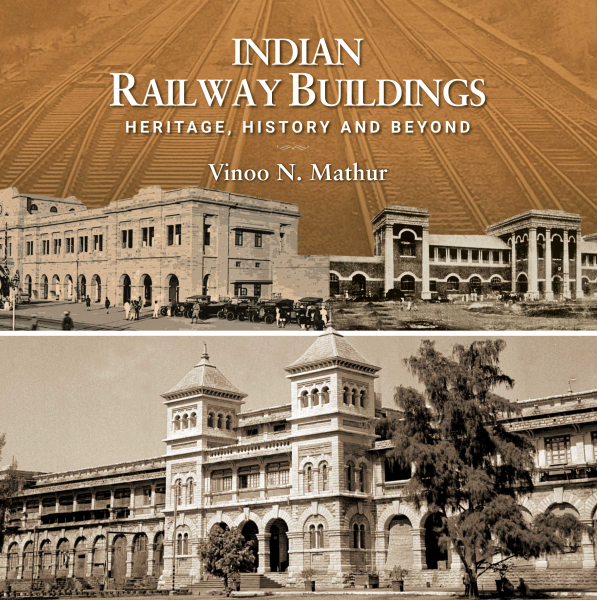
The book “Indian Railway Buildings” by Vinoo N. Mathur takes the reader on a fascinating journey through some of the most iconic railway buildings in India.
-
Extensively researched and packed with historical facts, this book is a treasure for all those who love to travel or explore the styles and designs of buildings from the comfort of their homes.
-
Focusing on the structures built during the mid-nineteenth to the mid-twentieth centuries, this book highlights the historical and architectural features of a significant number of railway buildings that were constructed during the days of the British Raj in India. Featuring historic information and many rare photographs about the construction of these structures, the author reveals interesting and little-known aspects about the heritage railway buildings of India.
-
Read an excerpt from the book below.
Cawnpore Station
Cawnpore (now Kanpur) was a major military and civil station on the East Indian Railway (EIR) route from Calcutta to Delhi. It lay on the first railway line that had been conceived by Lord Dalhousie when it was decided to build a railway system in India. The route was important both on strategic considerations, for moving troops to Central and North-west India, as well as from a commercial standpoint as it linked the major business and industrial centres on the Indo-Gangetic plains. Construction of the line began simultaneously on various sections of the alignment. The route was divided into the Bengal and the North Western Provinces section, which were further divided into construction district offices, which, for example, were located at Mirzapur, Allahabad (now Prayagraj), Cawnpore and Etawah. An experimental line from Howrah to Raniganj was opened in 1855 and construction on the main line proceeded rapidly thereafter. However, the 1857 War of Independence resulted in a break in construction activity. At Cawnpore, in particular, there was violence and bloodshed with heavy loss of life among the resident British population, both civilian and military, as well as women and children when Nana Sahib and, later, Tantia Tope, and their forces laid siege to the British entrenchment and subsequently attacked them at different locations. Despite the interruption in construction activity, the railway line from Allahabad to Cawnpore was opened to traffic in March 1859. The line had been operative earlier for moving troops and supplies. The section from Cawnpore to Etawah, towards Delhi, was opened in 1861.
The events of 1857 left an indelible mark on the British psyche and a number of memorials came up in Cawnpore such as the Memorial Church, a Memorial Well and Memorial Gardens in honour of the British who lost their lives. It is, perhaps, against this background that the East Indian Railway built its finest station building on this route with distinct classical revival architectural features.The building symbolised, in a way, the British recovery and re-establishment of their colonial rule and authority. An engraving of the station building was published in The Illustrated London News in 1867. Among the classical features, in their simplest form, were the Doric columns in the front verandah and porte-cochère, banded rustication on the walls and corner piers, a projecting cornice and fanlights above the entrance doors. On the rail side, the station had a broad platform with a segmental corrugated iron roof structure resting on one side on the main building and, on the other, on an arcade with vertical oblong openings on top, which provided for light and ventilation. The arches on both sides had hood moulding and the piers supporting the arches had plain pilasters running the full height of the building and arcade. The platform roof design, covering one line and a platform, was adopted at several stations on the East Indian Railway with minor variations.
The station had ample accommodation and Murray’s A Handbook for Travellers in India, Burma and Ceylon (1911) described the waiting rooms as ‘comfortable and convenient’.1 On the platform side wall, even today, the name of the station is engraved, ‘CAWNPORE’ with distances, ‘FROM CALCUTTA 632 MILES 962 TO BOMBAY’. As Cawnpore became the junction of different Company Railways—East Indian, Oudh &Rohilkhand, Bombay Baroda & Central India and the Indian Midland Railway—operations progressively became complex and, in the late 1920s, a new station was planned. The main EIR route was diverted away from the old station. The building still retains its old character; however, it is now used as a Civil Engineering Training Academy.
