

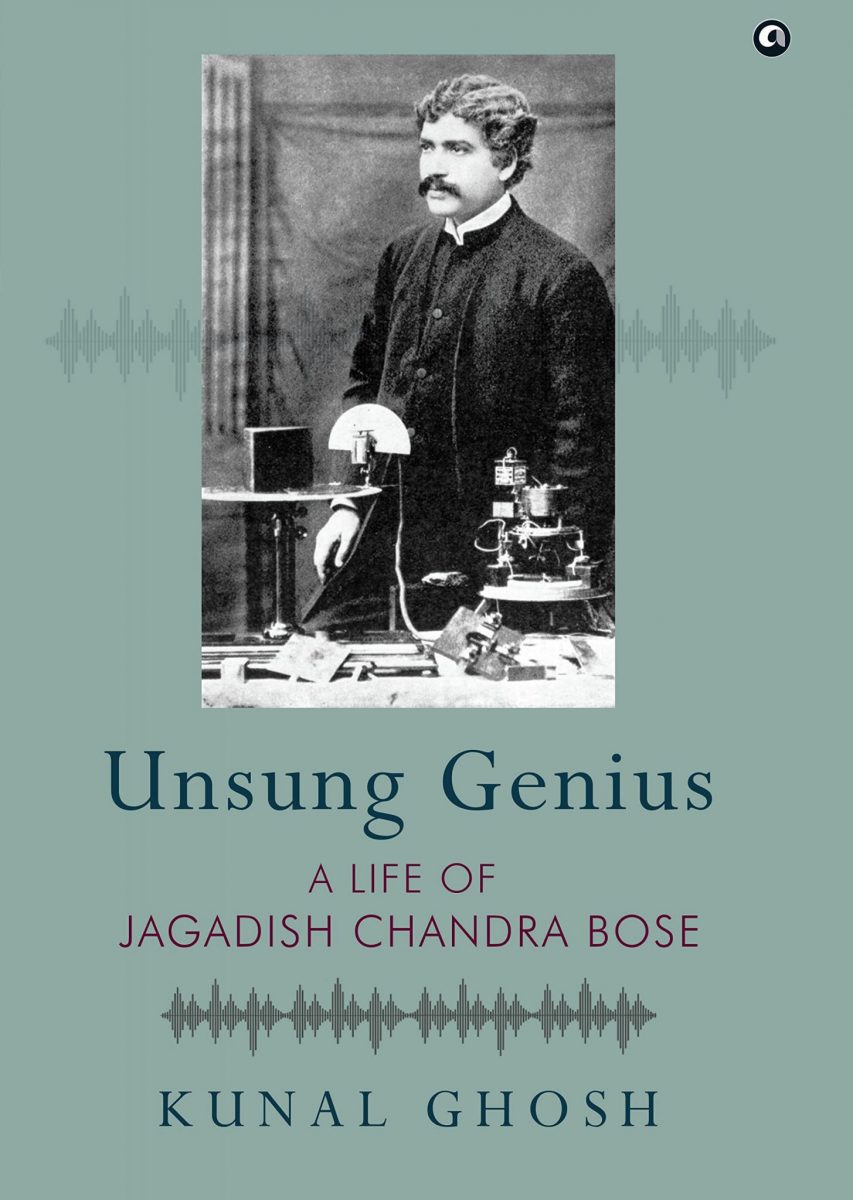
The book “Unsung Genius: A Life of Jagadish Chandra Bose” by Kunal Ghosh is the first in-depth biography of the scientist written in the twenty-first century.
Jagadish Chandra Bose, also called the ‘father of radio science’, was one of the most prominent figures of India’s scientific community. Between 1895 and 1900, Bose made remarkable contributions to certain fundamental aspects of modern physics. Then, his interest shifted to plant physiology and here, too, he was responsible for major discoveries and insights.
This exhaustive biography takes a close look at Bose’s early career as a physicist and his later work as a plant physiologist, and explains the magic behind some of his pioneering findings. It describes how he dealt with racial discrimination and academic plagiarism during his life, and how he found strength, inspiration, and support in the unlikeliest of places.
Read an excerpt from the book below.
Editor’s Note: The following excerpt has been taken from the preface of the book.
****
At the intersection of the twentieth and the twenty-first centuries, as the world celebrated 100 years of wireless communication and the radio, there arose a question—who invented the crystal semiconductor diode, perhaps the most crucial part of a functioning radio at the time? Researchers of science history in the US were surprised to find that it was Jagadish Chandra Bose, an Indian physicist, who held the first American patent on this piece of technology, also the first in the world. This resulted in renewed interest in this unconventional scientist and from that interest arose this book about Bose, the man, the quintessential nationalist, and the physicist-cum-physiologist, and an inventor par excellence whom the world has almost forgotten. This is also the story of the development of radio, its pioneers (Bose being one), and the controversy surrounding the Nobel Prize for Physics for the invention of radio.
The life of Bose the scientist followed a strange trajectory. Between 1895 and 1900, Bose made rapid and remarkable contributions to certain fundamental aspects of modern physics. His legacy to the field of radio engineering was a by-product of this which came about naturally, as though it was almost inevitable, considering the extraordinary inventor that he was. Then there was a sudden shift of his interest from physics to physiology, particularly to plant physiology. Here, too, startling discoveries were made and new inventions created.
Bose was a noted scientist between 1896 and World War II and many early twentieth century textbooks in physics featured his methods and apparatuses. He was elected a fellow of the Royal Society of London and appointed a member of the International Committee on Intellectual Cooperation after World War I. However, within a couple of decades of his death in 1937, the scientific world outside India seemed to forget him. In the face of this, I felt a need to examine the why and wherefore of this blackout through a fresh appraisal of history—what better way to achieve this than to write a biography of the man in question! It is my express desire to write an objective biography with a depiction of both strengths and weaknesses.
As early as 1895, newspapers and science journals in London were agog with the possibility of wireless communication using Bose’s inventions. It is no wonder then that Bose’s name figured in the controversy that started soon after the announcement of the Nobel Prize for Physics in 1909 or the ‘Radio Nobel’, as it was popularly known afterwards. The award was for research leading to wireless communication and Bose, an acknowledged pioneer in that subject, was altogether ignored by the Nobel committee. The prize was awarded to two other pioneers, the Italian Guglielmo Marconi and the German Karl F. Braun.
Since then, a few generations in India have grown up hearing rumours that Marconi had somehow made use of Jagadish Chandra Bose’s ideas to construct his device for wireless communication. There was a hint of foul play. The rumours almost attained the status of folklore amongst students of science in eastern and northern India, suggesting that Bose was denied proper recognition by the western world in an unjust manner. One variation of this lore is set in the early twentieth century in London. Bose, on an excursion to the capital of the United Kingdom from Calcutta, finds that a man has stolen his notes from his hotel room under the guise of paying the scientist a visit.
During the Victorian era, Calcutta was the capital of British India, and London the capital of the worldwide British empire at its pinnacle. At this time, Bose faced discrimination on the grounds of his race and nationality and was denied a fair salary on his appointment as a college professor in Calcutta. Clearly, the life of a native scholar working under British rule was difficult. It is, therefore, natural to suspect that race and colonial prejudice might have interfered with a fair assessment of his research contributions as well.
There was another complicating factor that played a role in his delayed recognition as a scientist par excellence—his refusal to accept hard and fast subject boundaries. He was a physicist, but he started researching physiology in all earnest, applying the tools of physics to that subject, to the chagrin of many. Physiologists, in general, did not approve of a physicist transgressing into their field of study. His troubles began when he started comparing the response of living tissues and non-living matter, thereby antagonizing some of the eminent plant and animal physiologists of the time. He refers to these acts of his own as breaching the ‘etiquette of a caste system’ that seemed to prevail among the scientists of the era. Within a few years, he produced startling results. Using his own invention, an instrument called the crescograph, he made plant growth visible to the naked eye. His other remarkable achievement was proving that plants were sensitive beings.
On occasions, at the end of a lecture or seminar, he expressed a profound philosophical belief in the unity of existence among all matter, living and non-living, which seemed far-fetched. But his published research papers and books were all matter of fact and never contained such flourish. His inventions, experiments, and discoveries, both in physics and plant physiology, stood repeated tests flawlessly. Yet the picture is not one of unmixed deprivation and suppression—a significant section of the scholars, academicians, scientists, press, administrators, and policy makers of the ruling nation tried to give him due recognition, but their efforts were thwarted by another group, in which some were motivated by pique, some by a combination of business interests and prejudice, and some, perhaps, by imperial policy.
There is a popular misconception, even in Indian academic circles, that Bose’s contribution is not so much to the science of wireless communication, but to the production and study of millimetre waves, which are today also called microwaves, a subcategory of radio waves. He did develop a device to produce millimetre waves, but studying them was not his purpose per se, nor was wireless communication.
Bose was aiming to verify certain fundamental laws of physics regarding radio waves, with the express purpose of putting to test Maxwell’s theory of electromagnetism, and to continue Heinrich Hertz’s work. This was necessary because Maxwell’s theory, at that juncture, had not been fully accepted by physicists who were still looking for comprehensive experimental verification of the theory. The generation of millimetre-size radio waves by Bose was only one of the steps in this endeavour. The task involved several other stages and inventions, and Bose’s effort was eminently successful and conclusive. Surprisingly, modern authors give sole credit for this to Hertz alone, although early twentieth-century textbooks had duly acknowledged Bose.
Bose was enthusiastic about bringing the study of science to the masses. Following in the footsteps of his teacher Father Lafont, he would organize public lectures on a variety of subjects. He understood that abstruse theory did little to excite public imagination and took to performing simple and attractive experiments in his lectures. One such lecture, in which he demonstrated the power of wireless signalling, attracted the attention of the world and came to acquire historic significance. He sometimes signalled playfully from one part of the college to another, much to the amusement of his students and friends. He invented a series of increasingly efficient receivers and other paraphernalia for these radio waves during the natural course of his research; these instruments formed his contribution to wireless communication.
