

-
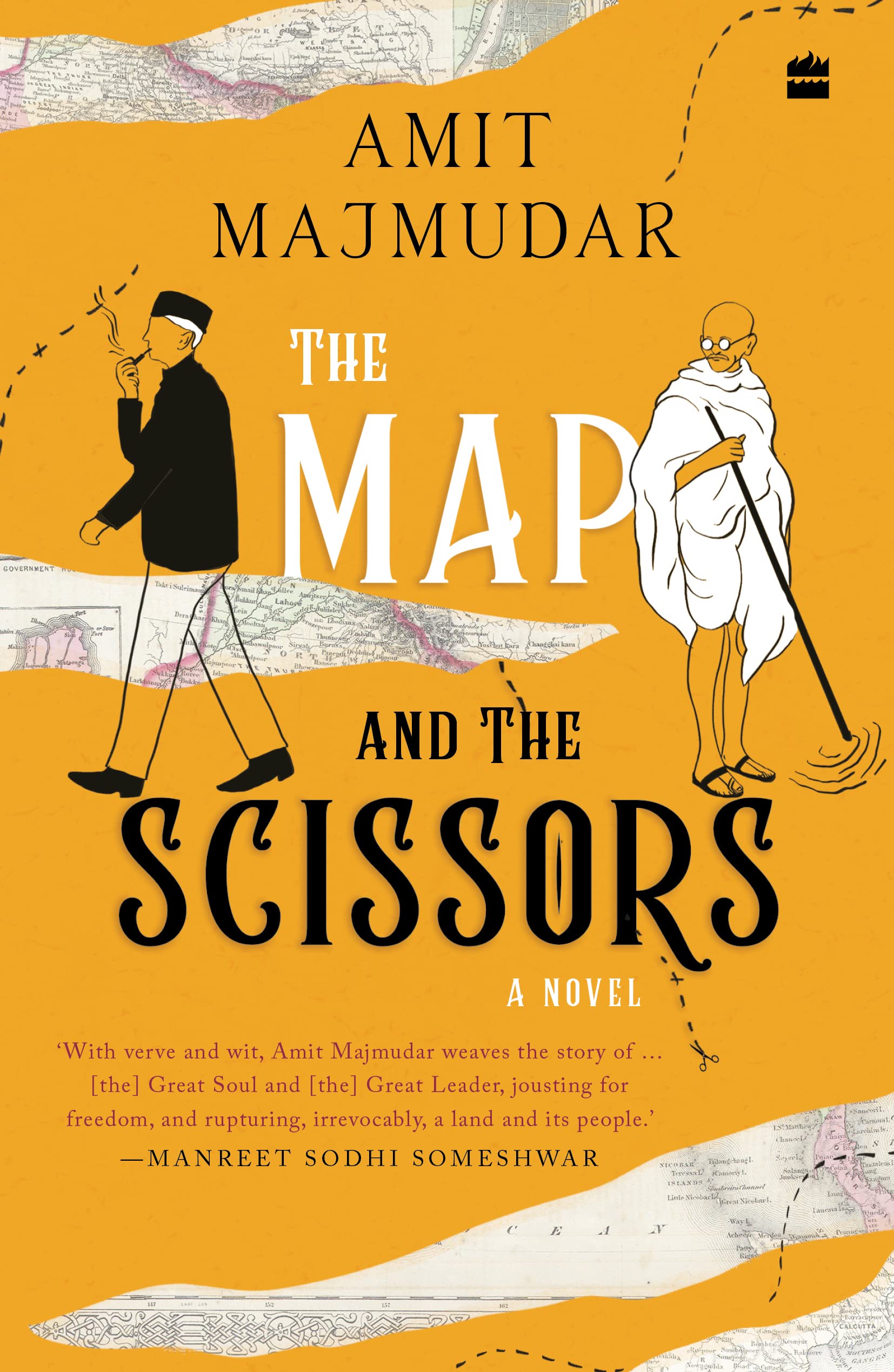
The book “The Map and the Scissors” by Amit Majmudar is about the epic origin story of modern South Asia, brought to life by two London-educated lawyers, mirror-image rivals who dreamt the same dream of freedom-in catastrophically incompatible ways.
-
Two intense, inflexible personalities duel over a question that will decide the fate of millions: one nation-or two?
-
Jinnah, the consummate, ruthlessly analytical gentleman in a tailored suit, starts out sceptical of those who come to his door proposing a ‘Land of the Pure’, but ends up founding exactly such a country. Gandhi, the religious visionary in homespun khadi, experiments with Truth in his quest for one India-only to witness, in anguish, the bloody birth of two nations.
-
Read an excerpt from the book below.
1893. Regress Mohammed Ali Jinnah, father of Pakistan, back to a law student in London. Subtract three thousand cigarettes from his body, and his beauty grows delicate. So what if he is a common merchant’s son from Karachi, picked out for his quick tongue? His look is princely.
Young Jinnah has a copy of Blackstone’s Commentaries on the Laws of England open on his lap. Inside it nestles a copy of Othello: the blackamoor, the Mussalmaan, the odd man out is moving his lips with the lines.
Something about him takes naturally to acting. London is full of the sons of wealthier Indians, studying business or medicine or law. Some pass all their tests but fail their auditions as Englishmen, their tongues never quite writhing out of their accents. Even worse are the out-of-place Indian hand gestures that accompany their Indian English, the figure-eights their heads make when they say yes, their inability to eat pork sausages with the white students as if pig were no different than mutton or beef.
Not so Jinnah. He inhabits his character. One of the first professors he sees in the lecture-hall uses a monocle to review his notes. The same evening, the young student goes out and buys one for himself, shells the monocle lens off the frame, and reads his textbook before the mirror, practising his w’s and v’s, making sure he keeps them straight. Eventually, he gets his first bespoke three-piece suit and models that with the monocle.
Those first textbooks were economics. His businessman father sent him ‘across the black water’ to study business, like a properly money-minded Gujarati son. But Jinnah switched, without permission, to study law at Lincoln’s Inn.
He likes law because he feels like he’s playacting. The costume he dons during the day happens to be a barrister’s black gown. In the evenings, he has done with half measures and rolls his knee-high black socks over his trouser legs: Elizabethan breeches. A turned-up collar serves for a ruff.
He leaves the library early this afternoon, murmuring, Then must you speak / Of one that loved not wisely but too well; / Of one not easily jealous but, being wrought / Perplexed in the extreme; of one whose hand / Like the base Indian, threw a pearl away / Richer than all his tribe. The dry cold has fissured his lower lip. When he licks it, he tastes blood.
Back at his lodgings, a slight English girl blocks him on the way to his room. Her red lips startle him; she has painted them an inch thick.
‘Miss Page-Drake,’ he says respectfully, warily.
He has been only three years in London, but already his accent is just as English as hers. It’s as though the Gujarati he spoke in his parents’ home had been a mere placeholder, and his tongue had been shaped to these words all along. In fact, his landlord’s daughter speaks an English coarser than his. Jinnah would never put an r sound at the end of ‘India’.
‘Do they have mistletoe back in Indier?’ She is pointing up, mischief in her eyes, and adoration.
The handsome young foreigner looks up and sees a small weed of some sort pinned to the ceiling.
‘Mistletoe,’ says Miss Page-Drake, meaningfully.
‘Lovely.’
‘Christmas tradition and all.’ She waits, her cheeks colouring. ‘Past two years I let you off easy, but now you’re a proper Englishman, Mr Jinnah.’
‘I fear I have an important engagement,’ he says in a rush, raising his Othello as a shield. The young girl steps towards him, leading with her lips, and he slips his thin frame past her, nudging a picture on the wall askew and hastily righting it as he passes.
His ‘important engagement’ is at a West End theatre. For the first time in his life, he steps on to a stage. It is bare and half-lit, and six people make up his first audience: the theatre owners, James and Tamyra Quentin; the Scottish student who recommended he audition; a few of the company actors (all socialists, outraged about their own Empire); a poet; and the fellow sweeping the aisles.
Jinnah gives them Othello. He even answers himself, his own Iago. The Quentins ask for more, and he gives them Now is the winter of our discontent, his spine curving. He snarls and whinges and thunders. This play on the emotions, this wordplay, this inhabitation of a perspective—arguing law simply could not match it. This is freedom.
When he steps down from that high, Jinnah only vaguely registers handshakes and slaps on the back. The spell has not completely broken.
‘We’ll sign you,’ says Mr Quentin.
His wife, enthusiastically clutching her husband’s arm, beams at this dark charismatic youth, his features beautiful and sinister, boyish and wolfish.
Jinnah notices her, his eyes still distracted, almost drugged. ‘Othello?’
‘Romeo,’ she whispers.
From ancient grudge break to new mutiny, he says giddily, Where civil blood makes civil hands unclean.
The fountain pen with which he signs the contract that evening ruptures all over his fingers. He rushes to the washroom—but in his exhilaration at catching a future Romeo’s face in the mirror, he laughs aloud and licks off his fingers this sweet black juice.
That night he writes home to his father. This is the first of his negotiating techniques: present the fait accompli. Last time, when he informed his father he had switched from business to law, he added that he’d paid his dues to Lincoln’s Inn up front. He knew that a proper businessman like his father would not sign off on the loss.
The letter sails home to Karachi, where it lands on his father’s bare desk in the young man’s childhood home. Weeds have broken stone, and moisture blotches the walls like tears and kohl running down a cheek. Young Mohammed Ali, the eldest son, was sent to England at great expense to become a maker of money, not a mouther of lines. The patriarch dips his pen in the bitter black juice of reproach, the poison Romeo will have to drink.
The letter races to London, black with news from home. It arrives with a murder of crows outside Jinnah’s window. Well before he finishes reading it, his head in his hand, forehead sweating against his palm, he begins to nod in resignation to his role. Parentage is destiny.
He does not sleep that night. Before dawn in the still dark room, he puts on his barrister’s black robe; adjusts his cufflinks; sets his monocle in place; and combs a sharp parting in his hair.
The sun has risen. He draws aside the curtains and squints into the spotlight of his future.
Excerpted with permission from The Map and the Scissors, Amit Majmudar, HarperCollins India.
