

-
The book “Adbhut: Marvellous Creatures of Indian Myth and Folklore” by Meena Arora Nayak hides within its pages creatures that are mysterious, terrible, and terrifying, yet fascinating and irresistible.
-
Divided into five sections, this book portrays familiar and unfamiliar beings that fly across stormy skies, swim in deep seas, burrow through the earth, tread softly on land, and live between these realms, sometimes even breathing fire.
-
Meena Arora Nayak is a professor of English and Mythology.
-
Read an excerpt from the book below.
BUDDHA THE WHITE ELEPHANT
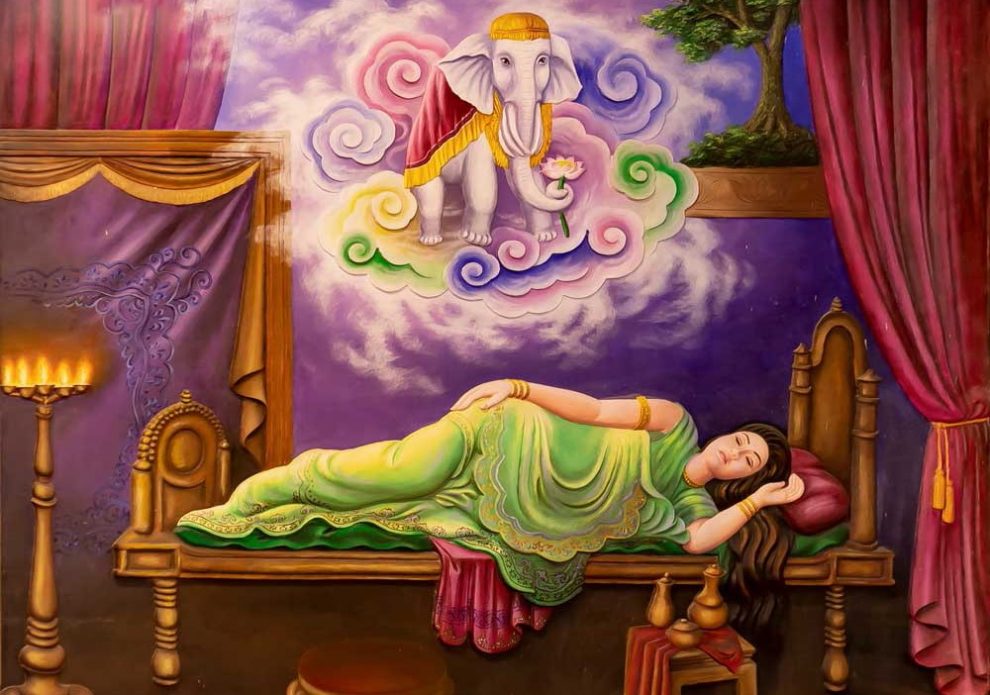
For seven days before the full moon, Queen Maya participated in the festivities of the midsummer festival. On the seventh day, she rose early and bathed in water perfumed with roses and sandalwood. After distributing wealth among the destitute and holy, she returned to her rooms and, dressing in queenly finery, lay down on her royal couch to rest. Soon, she fell asleep and, in her sleep, she had a dream: the guardian gods of heaven were lifting her couch and taking it to a crimson plain in the Himalaya. There they placed the couch under a great sala tree. Then the queens of the gods took Queen Maya to Lake Anottota and bathed her in it. Adorning her with heavenly flowers, they brought her to a golden mansion on Silver Hill and lay her on a divine couch, turning her head to the east. Then, the Bodhisattva, in the form of a pure white elephant, holding a white lotus with his silver trunk, approached the golden mansion from the north, and circumambulating Queen Maya three times, struck her side and entered her womb.
When Maya woke up, she shared her dream with her husband, King Sudodhana. The king summoned sixty-four eminent Brahmins and, honouring them with wealth and milk and honey, requested them to interpret the queen’s dream.
‘You will have a son,’ the Brahmins told the king. ‘If he adopts a householder’s life, he will become a king, a universal monarch. But if he leaves his home and adopts a religious life, he will become a Buddha, full of compassion, who will remove veils of ignorance and sin from the world.’
*
Once, the Bodhisattva was born as a chaddanta elephant of six tusks. Chaddanta was pure white, and his face and paws were bright red. He lived near a lake in the golden cave of Kanchanaguha with his two queens, Mahasubhadda and Chullasubhadda. One day, the younger queen suffered some inadvertent humiliation at the hands of the elder queen, but Chaddanta sided with the elder. The younger queen was peeved, and she carried this grudge with her into the next life. In her new birth, she married the king of Varanasi and persuaded him to send a hunter to find Chaddanta in Kanchanaguha and cut off his tusks. The hunter, Sanuttara, searched for Chaddanta’s cave for seven years, seven months, and seven days, and when he finally found it, he trapped the elephant and shot him with a poisoned arrow. The wounded Chaddanta turned to charge at him, but when he saw that the man was dressed in a saffron robe, he stopped. Then, knowing what the hunter wanted, he sawed off his own tusks and handed them to him. When Sanuttara brought the six trunks back to the queen, she died of shock.
Another time the Bodhisattva was born in a Himalayan forest as Silava, a white elephant. His body was like silver, his eyes were like diamond balls, his mouth was red, like scarlet velvet, his trunk was silver, flecked with red gold, and his four paws looked like polished lac. One day, while he was walking in the forest, he met a man who had lost his way and was in great distress. Filled with compassion, Silava raised the man onto his back and took him to the path that led to Varanasi. But this was a greedy man. As soon as he arrived in Varanasi, he went to the market and enquired about the price of ivory. Then he went to Silava and asked him for his tusks. The elephant agreed to have half his tusks sawed off. The greedy man sold the half tusks, spent the money, and then returned to Silava for more. Silava let him saw off the remainder of the tusks, as well. But the man came back again; this time to take the stumps. Climbing onto Silava’s head, which was like Mount Kailasha, he wrenched the stumps out from the flesh and left Silava bleeding to death.
After selling the stumps of ivory, as this man was returning home, a great big flaming chasm opened in his path and swallowed him. He ended up in the bowels of the earth, suffering the torments of hell.

Excerpted with permission from Adbhut: Marvellous Creatures of Indian Myth and Folklore, Meena Arora Nayak, Aleph Book Company.
