

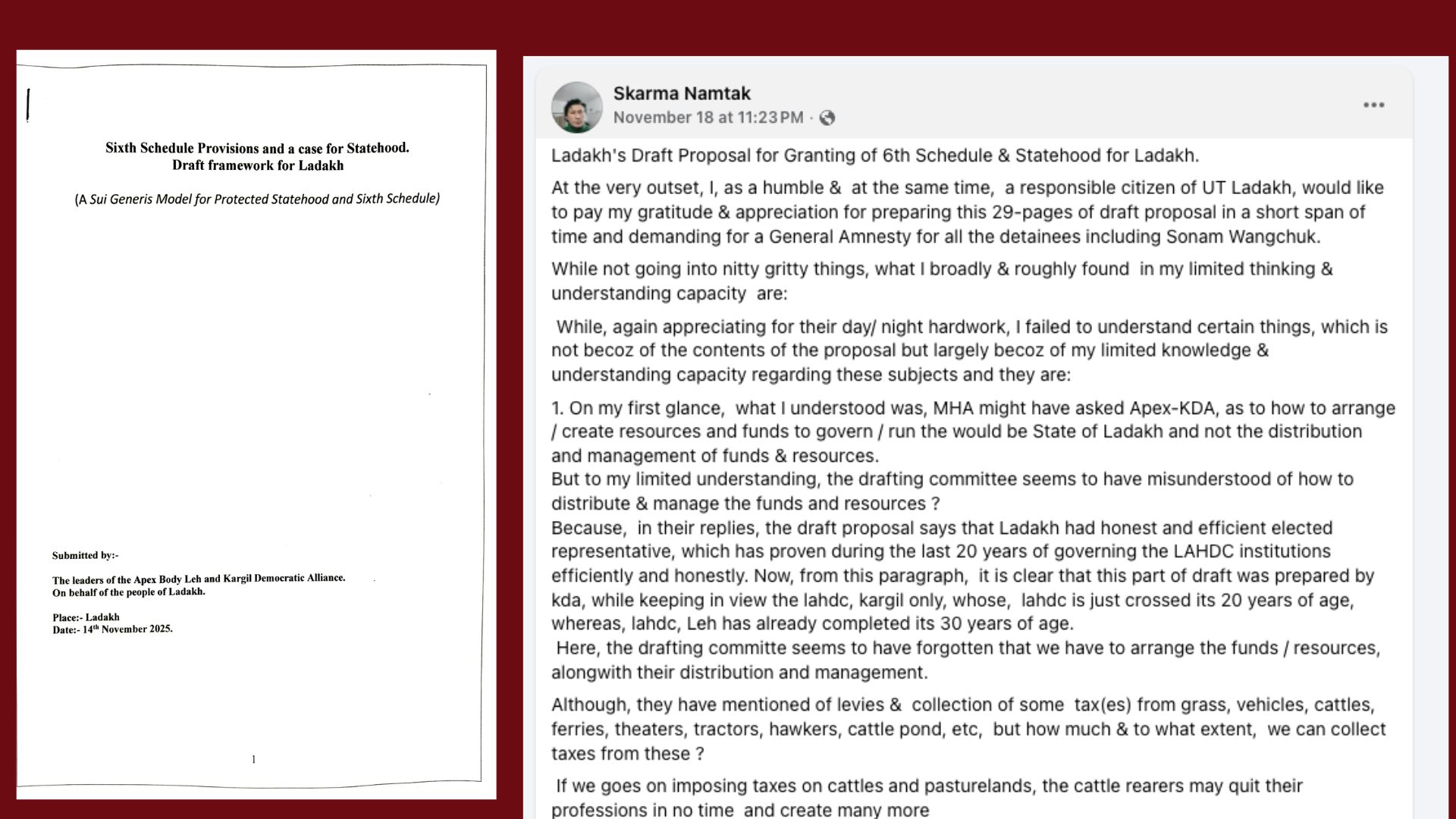
Leh: A recent 29-page draft proposal seeking 6th Schedule status and statehood for Ladakh has sparked public discussion, with some citizens raising questions about its financial and administrative framework.
Skarma Namtak, Managing Facilitator at Ladags Apricot Store, expressed both appreciation and concern over the proposal in a Facebook post.
He lauded the drafting committee for preparing the detailed document in a short span and for advocating a general amnesty for all detainees, including activist Sonam Wangchuk.
However, Namtak highlighted areas he found difficult to understand, citing his limited knowledge of administrative and financial matters. “
While the proposal emphasizes the honest and efficient governance of LAHDC institutions over the last two decades, it seems focused on distribution and management of funds rather than how to generate resources for a future state,” he wrote.
He also raised concerns over taxation plans mentioned in the draft, including levies on pasturelands, cattle, and local businesses.
Namtak cautioned that excessive taxation on cattle rearers could disrupt livelihoods and potentially increase migration to nearby urban areas.
He questioned the proposed mechanism of tax collection through the Autonomous District Councils (ADCs), suggesting it may lead to unequal benefits among districts.
The draft’s approach to legislative delimitation also drew his attention. While constituency reservations for Scheduled Tribes are based on population, Namtak asked whether geographical area could also be factored into such decisions.
Additionally, he queried the proposal’s plan to continue only the Leh and Kargil ADCs as corporate entities, leaving unclear the status of the five proposed new districts.
Namtak emphasized that his observations were not criticisms but reflections aimed at fostering public discussion and clarifying aspects of the draft proposal.
The draft, which aims to outline a framework for Ladakh’s future governance, continues to generate debate among citizens, policymakers, and experts as the region explores its path toward potential statehood and enhanced autonomy.
