

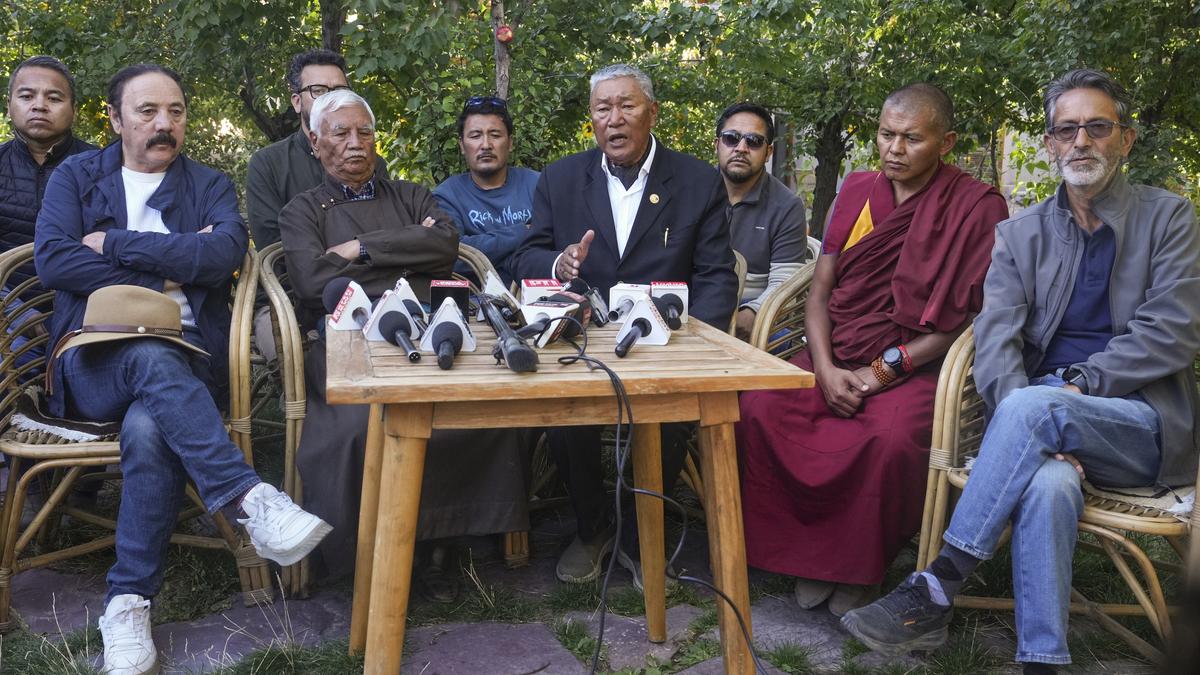
LEH: The Ladakh leaders have submitted an extensive draft framework to the Union Home Ministry, demanding the creation of a full-fledged State of Ladakh equipped with Sixth Schedule protections and a new Article 371-K offering region-specific constitutional safeguards.
The proposal, jointly submitted by the Apex Body Leh (ABL) and the Kargil Democratic Alliance (KDA), marks the most detailed and structured effort yet to define Ladakh’s long-term political future.
Exclusively accessed by Indus Dispatch, the 25-page document titled “A Sui Generis Model for Protected Statehood and Sixth Schedule” offers a dual-pronged legal mechanism combining a statehood act and a constitutional amendment—described by Ladakhi leaders as the first fully workable roadmap since 2019, when Ladakh was carved out as a Union Territory without a legislature.
The submission comes amid renewed political tensions following the death of four youth during protests on September 24, 2025.
At the very outset, the draft calls for a general amnesty for all detainees—including environmentalist Sonam Wangchuk—terming it an essential “confidence-building measure” to revive faith in the ongoing dialogue with the Centre.
Click here to read to full draft of demands submitted by LAB and KDA to MHA
Two-Part Constitutional Roadmap for Ladakh
The proposal lays out an elaborate legal plan consisting of:
1. The State of Ladakh Act, 2025
A complete draft law for the formation of India’s 29th state.
2. The Constitution (129th Amendment) Act, 2025
A comprehensive amendment to bring Ladakh under the Sixth Schedule and insert a new Article 371-K for the region’s cultural, environmental, and demographic protection.
Together, the documents aim to address what Ladakh’s leaders call a “legislative vacuum” created after the revocation of Article 370 and loss of Ladakh’s former assembly and protections.
What the Ladakh Leaders Have Actually Submitted
At the core of the proposal is a fully drafted State of Ladakh Act, 2025, which lays out the structure of a new state in precise legal detail. Key components include:
A 30-Member Legislative Assembly
The Act proposes an elected 30-seat assembly, with an unprecedented 28 seats reserved for Scheduled Tribes, reflecting Ladakh’s demographic reality.
Enhanced Parliamentary Representation
The draft allocates:
- Two Lok Sabha seats, and
- One Rajya Sabha seat
for the future state.
Judicial Structure
A common High Court for J&K and Ladakh will continue, but with a mandatory Ladakh bench operational within one year of statehood.
Administrative Transition
Detailed provisions outline the transfer of:
- Assets
- Liabilities
- Personnel
from the current UT administration to the new state government.
State Public Service Commission
A dedicated Public Service Commission for Ladakh is proposed for recruitment and administrative oversight.
The proposal justifies statehood on the grounds of historical representation, Ladakh’s strategic importance, geographic uniqueness, and its proven record of democratic functioning through Hill Development Councils.
Sixth Schedule
Calling Ladakh “a predominantly tribal region with more than 90% ST population,” the document demands its notification as a Tribal Area under the Sixth Schedule—a safeguard Ladakh’s leaders argue is critical after the removal of earlier protections under Article 35A.
The proposal recommends replacing the current Leh and Kargil Hill Councils with constitutionally empowered Autonomous District Councils (ADCs). These ADCs would have significant powers across 31 key sectors, including:
- Land allotment and ownership
- Mining, quarrying, and resource extraction
- Grazing rights, kahcharai, and shamlat lands
- Cultural and linguistic preservation
- Tourism, education, and public health
- Environmental conservation
- Control over employment up to Group B posts
- Local taxation, tolls, and service fees
- District planning and budget formulation
Crucially, ADCs would have the authority to restrict alienation of land to non-tribals and non-permanent residents, addressing a core public concern in Ladakh.
Article 371
The proposal further seeks insertion of a new constitutional article—Article 371-K—which would:
- Protect Ladakh’s cultural and religious heritage
- Safeguard demographic stability
- Guarantee special rights over land and natural resources
- Ensure that local customs and governance traditions are preserved
- Provide flexibility for tailored administrative systems
This would put Ladakh alongside states like Nagaland, Mizoram, Sikkim, and Himachal Pradesh that enjoy special constitutional protections.
The submission follows months of frustration among Ladakh’s population. In their document, ABL and KDA point out that the May 27, 2025 meeting with the Home Ministry had resolved the long-pending issue of domicile eligibility for government jobs—capping it at 15 years of continuous residence since 2019.
However, after that meeting, the expected follow-up round of talks never materialised.
Ladakhi leaders say this silence contributed to public unrest and led to the unfortunate violence and deaths in September. They welcome the government’s decision to order a Supreme Court-monitored judicial inquiry but argue that the Centre must “urgently address Ladakh’s core political questions” to restore public trust.
