

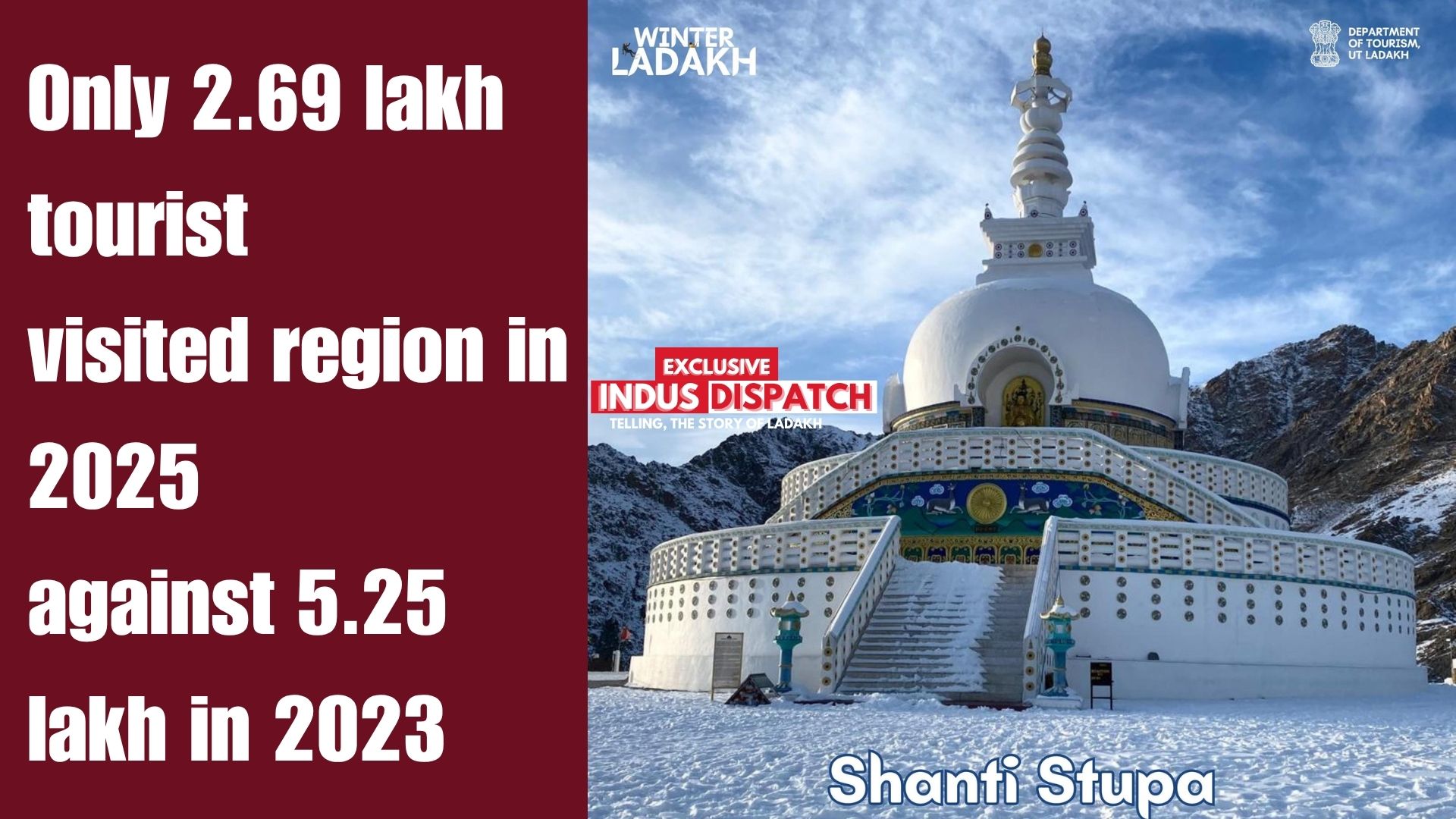
Jammu, October 5: Ladakh’s tourism industry, which is considered as the economic lifeline of the Union Territory, is facing one of its toughest phases, with tourist arrivals plummeting sharply in 2025 following the recent violence in Leh and the India-Pakistan hostilities during Operation Sindoor earlier this year.
According to official data shared by the Directorate of Tourism, Ladakh, with Indus Dispatch, the region has recorded a nearly 50 percent decline in tourist arrivals this year (till August 31) compared to 2023.
“As many as 2,69,390 tourists visited Ladakh till August 31 this year, compared to 5,25,374 in 2023 and 3,76,386 in 2024,” the data revealed.
In 2023, Ladakh received 36,315 foreign and 4, 89,059 domestic tourists, while in 2024, the numbers stood at 39,704 foreign and 3, 36,682 domestic visitors.
Officials and stakeholders attribute the slump to the prevailing unrest and security concerns among travelers. The violence that erupted in Leh during the 15th day of 35-day-long fast of climate activist Sonam Wangchuk who has been detained under the National Security Act (NSA)—has cast a long shadow over the tourism sector.
“Tourism and allied industries have been badly affected by the recent incidents,” said Rigzin Wangmo Lachic, President of the All Ladakh Hotel and Guest House Association, Leh.
“We have witnessed nearly a 50 percent drop in business since June. Earlier, the Pahalgam incident had already led to a complete halt in April and May. Now, the killings of four people and a suicide have left everyone deeply disturbed,” she told Indus Dispatch.
Lachic pointed out that around 80 percent of Ladakh’s economy is tourism-driven, and the ongoing crisis has triggered a ripple effect across all sectors.
She said, “This year has been particularly challenging for the tourism industry in Ladakh. The season began with a sharp 50% decline in tourist arrivals following the unfortunate Pahalgam incident, and was further disrupted by the unprecedented rains here and in neighbouring states. Now, with this recent tragedy, the crisis has deepened”.
“Tourism is the lifeline of Ladakh, and every stakeholder; whether hotels, guest houses, homestays, cafés, restaurants, taxis, or even bike rentals; represents not just individual enterprises but the livelihoods of a major percentage of our population. Most have built their businesses from scratch with heavy bank loans, and today they stand under immense financial stress,” Lachic said. “After the Pahalgam incident, we sought a one-year moratorium, which was approved but not yet implemented. We are now submitting another representation to the UT administration tomorrow, seeking an interest subvention package,” she said.
However, Lachic observed that economic concerns have now taken a backseat to public sentiment demanding justice. “People are not talking about losses anymore. What they want is a judicial inquiry into the firing incident that killed four protesters. The community is still in shock over how security forces opened fire on civilians,” she added.
Pertinently, four persons were killed and over 90 others injured, including 30 police and CRPF personnel, after violent protests, arson and clashes rocked Leh town on September 24 following the shutdown call given by Leh Apex Body (LAB) youth wing, backed by social, religious and student groups.
The LAB has suspended the dialogue with MHA while seeking judicial probe into the incident. The UT administration has ordered a magisterial inquiry into the recent violent protests—a move that has been categorically rejected by LAB and Ladakh Buddhist Association (LBA) by terming it as an “eyewash”.
